How To Make Restaurant Style Finger Millet Dosa at Your Home

Written by: Two Brothers Organic Farms:

Guess what? Now you can whip up a mouthwatering, crispy dosa that rivals the ones you’d get at a fancy restaurant, right in your own kitchen! I used to dream about making dosa that perfect, and trust me, with this recipe, it’s totally doable. Even if you, like me, struggled with dosa-making in the past, this foolproof recipe will change the game. I can now make dosa with my eyes almost closed—okay, maybe not literally, but you catch my drift. It’s as good as the authentic South Indian dosa, made by fermenting batter with different dals. And here’s the twist: I’ve made it even healthier by tossing in some healthy sprouted finger millet malt. Millets are super good for you, so it’s a win-win for your kitchen and your diet! Ready to learn how to make ragi dosa? Let’s dive in!

Ingredients

  • ½ cup Ragi flour (see below how whole finger millet/ragi looks like)
  • ½ cup Semolina (Suji or Rava)
  • ¼ cup Rice flour
  • Curd
  • Chopped Onions
  • ½ tsp Grated Ginger or ginger paste
  • ½ tsp Cumin seeds
  • Chopped Coriander
  • Curry leaves
  • Salt

Method

  • Mix all the ingredients thoroughly.
  • Add water to achieve a dosa batter consistency—neither too watery nor too thick.
  • Let the batter rest for 10 minutes.
  • Heat a dosa tawa. Add oil and let it heat.
  • Reduce the flame, sprinkle some water on the tawa, and wipe it with a cloth.
  • Pour a small ladle of dosa batter onto the tawa. Spread it evenly and let it cook.
  • Drizzle oil around the edges and in the center.
  • When the dosa edges start lifting from the tawa, use a flat spatula to flip it.
  • Cook the dosa for another minute or until you achieve the desired texture and color.
  • Serve hot with coconut or peanut chutney.

Tips to Make It Right

  • Sooji Grinding: Forget using sooji as is. To get the perfect dosa, grind it into a fine powder. Letting it sit won’t give you the right crispiness – trust me on this.
  • Poha or Rice Flour: Add some poha (rice flakes) to the mix for that extra crispiness. If you don’t have poha, rice flour works too. It’s the secret ingredient for a dosa with the right crunch.
  • Whole Wheat Flour: For a batter that spreads like a dream on the pan, throw in some whole wheat flour. It’s the glue that holds everything together. Here are some other healthy flour options you can opt for.
  • Sugar Boost: Don’t freak out about the sugar. It won’t turn your dosa sweet. It’s there to give your dosa a beautiful brown color, just like the ones you get in restaurants. Plus, it adds a little extra flavor.
  • Batter Consistency: Forget fancy pans – the real game-changer is the batter consistency. Not too thick, not too thin. Follow the recipe closely, and you’ll nail that perfect in-between texture.
  • Heat Control: The right heat is key. Too hot, and your batter won’t spread. Keep the flame medium, sprinkle a bit of water before each dosa, and watch the magic happen. It cools down the pan just enough for that smooth spread.
  • Handling the Oil: You might think oiling the pan is the way to go, but trust me, it’s a trap. Learn from my mishaps – oil hinders the batter from spreading easily. Skip it, and your dosa will thank you later.

Closing Thoughts

There you have it – your guide to creating the perfect crispy ragi dosa at home. With a few handy tips and this foolproof recipe, you’ll be impressing yourself and others with your dosa-making skills in no time. So, gather your ingredients, fire up that dosa tawa, and let the aroma of wholesome, finger millet goodness fill your kitchen. It’s not just about making dosa; it’s about turning a once-elusive dream into a delicious reality. Happy cooking!

Jackfruit Croquettes / Cutlets

Jackfruit croquettes are a great meat free snack or starter thanks to its ease of preparing alongside it’s amazing taste! Jackfruit here is a great alternative to meat due to its similar texture.

They can be made from a mixture of spiced onion, potato, and cooked (& minced) jackfruit, which are then rolled into bite size balls. Later coated in a flour and water mixture so that breadcrumbs can stick evenly around the croquette. Fry the balls until they are golden brown. Serve hot with any sauce or chutney you like! I served it with my homemade apricot chutney made with fresh apricot fruit.
Ingredients

  • Young green jackfruit – I tin (540 gms net wt, 270 gms drained wt)
  • Potato (big) – 1 (around 265 gms)
  • Boiling Jackfruit:

  • Water – 3 cups
  • Ginger & garlic paste – 1 tsp
  • Turmeric powder – 1/4 tsp
  • Coriander powder – 1/2 tsp
  • Garam masala -1/2 tsp
  • Pepper powder – 1/2 tsp
  • Fennel seeds powder – 1/2 tsp
  • Kashmiri chilli powder – 1/2 tsp
  • For jackfruit mixture:

  • Oil – 3 tbsp
  • Shallots – 100 gms
  • Ginger & garlic paste – 2 tsp
  • Green chillies – 2
  • Kashmiri chilli powder – 1 tsp
  • Coriander powder – 1 tsp
  • Pepper powder – 1 tsp
  • Turmeric powder – 1/4 tsp
  • Fennel seeds powder – 1 tsp
  • Coriander leaves – 1/3 cup
  • Lemon juice – 1 tbsp
  • For coating/dredging/breading:

  • Flour / Maida – 3 tbsp
  • Water – 1/4 cup
  • Salt (optional) – a pinch
  • Breadcrumbs – 1 cup
  • For making breadcrumbs:

  • Bread – 3 slices
  • Optional ingredients:

  • Cashew nuts (optional) – 7
  • Raisins (optional) – 1 tbsp

Method

  • Finely chop the shallots & green chillies and keep them aside.
  • Boil the potato and allow it to cool.
  • Peel, mash and keep aside.
  • Heat oil in a pan and fry roughly chopped cashew nuts until light golden. This step is optional. You can even directly add the cashews to the jackfruit mixture just before making the balls.
  • Drain the water from the jackfruit and keep aside.
  • Boiling jackfruit:

  • Add all the spices to a vessel.
  • Add in 3 cups of water along with some salt to taste.
  • Bring the water to boil and add the tender jackfruit pieces and cook well.
  • I cooked until all the water is absorbed and all the flavour of the spices are absorbed by the jackfruit.
  • Allow it to cool and transfer to a plate.
  • Shred the jackfruit pieces & mince to the required texture as shown in the video. Alternatively, you can use a food processor to grind it to a coarse paste.
  • Heat oil in a pan. Add in the chopped onions and sauté until it is soft and translucent.
  • Add chopped green chillies and sauté for a few seconds.
  • Add in the ginger & garlic paste and cook until the rawness goes away.
  • Lower the flame, add all the dry spices and mix well. Cook for about a minute on a low flame. Take care not to burn this he spices.
  • Add the minced jackfruit to a pan and mix well with the onion mixture.
  • Cook for about 10 minutes on a low flame until the jackfruit is mixed well with the other ingredients in the mixture.
  • Switch off and allow the mixture to cool.
  • Refrigerate the jackfruit mixture for a couple of hours or overnight.
  • Remove the jackfruit mixture from the fridge about an hour before preparation to bring it to the room temperature.
  • Add the mashed potato to a wide bowl.
  • Add in the jackfruit mixture, coriander leaves, lemon juice and salt. Mix well.
  • Make equal sized round balls as shown in the video and keep aside.
  • Dredging/Breading:

  • Make flour paste by mixing flour and the required quantity of water. Optionally, you can also add a pinch of salt.
  • The paste should not be too thick or thin, but just enough to coat the balls nicely.
  • Keep the flour paste and breadcrumbs ready for dredging.
  • Dip the balls in the flour paste and then drop it in the breadcrumbs.
  • Roll the balls in the breadcrumbs to coat evenly and well. Keep the breaded balls in a separate plate.
  • Frying the croquettes:

  • Heat enough oil in a vessel for deep frying.
  • Check for the right temperature by dropping a small piece of the breadcrumbs. It should sizzle and immediately rise to the top if the temperature is right.
  • Do not stir immediately and turn gently after sometime to keep the coating intact.
  • Stir and turn occasionally to evenly cook.
  • Fry until the croquettes are golden brown in colour and crispy. It took me just over 4 minutes to cook.
  • Remove the fried croquettes to a kitchen tissue to remove excess oil.
  • Place the croquettes in a rack or in a sieve as shown in the video to help keep the croquettes nice and crispy.
  • I have served this with my homemade apricot chutney. You can serve this with any sauce or chutney you like.

Notes

  • You can also grind the raw jackfruit to a coarse paste and add directly to the onion spice mixture directly. Cook a bit longer until the jackfruit is nicely cooked and combined well with the onion mixture.
  • You can use biryani masala instead of the garam masala while boiling the jackfruit.
  • If you are using fresh jackfruit instead of tinned, just cook directly in the onion mixture until it is cooked. It will take more time compared to the tinned ones.
  • For making dry breadcrumbs, lightly toast the breadcrumbs and allow it to cool. Then, grind before storing it in an airtight container to get a long shelf life.

Mango pudding

Mango pudding is a great dessert for Mango lovers. It is smooth, creamy, silky and most importantly full of mango flavour. The best part is that it is very easy to make. I have used fresh alphonso mango for this mango pudding and another ingredient to highlight is coconut milk. I have used vegetarian gelatine powder. I have also used cream with the coconut milk to make it richer. Mango and coconut milk go very well together and make this dessert all the more exotic. The dessert becomes vegan by just avoiding cream and instead using more of coconut milk.

There are many varieties of mangoes. My favourites are Banganapalle mangoes (also known as Benishan) and Alphonso. You can use any good, sweet and fresh mango. Avoid very fibrous mangoes for this recipe. You can also use tinned mango puree when fresh mangoes are not available or not in season.

Banganapalle

Alphonso

When the kids are at home during school holidays, my photo shooting becomes immensely difficult. I just left the dish and camera for a moment and something silly was done – see the picture below 🙂

Preparation time: 15 mins

Cooking time: 25 mins (excluding time to set)

Cuisine: Asia and India

Serves: 3

Ingredients

  • Alphonso mango – 1 big (about 280 gms)
  • Coconut milk – 100 ml
  • Double cream – 50 ml
  • Caster sugar – 3 tbsp
  • Vegetarian gelatine powder – 2 tsp
  • Water – 150 ml

Method

  • Heat a small pan with about 50 ml water. Add 2 tsp of vegetarian gelatine to it. Mix gently. Set aside for about 10 minutes and it becomes a thick mixture.
  • I did this by following the instructions that came with the gelatine.
  • Rinse to clean your mango under running water and keep it aside.
  • Peel the skin and cut the mango roughly to small pieces.
  • Reserve about 2 tbsp of the chopped mango and the blend the rest.
  • The mango puree will come to about 3/4 cup approximately.
  • Add all the chopped mango pieces, sugar, coconut milk and blitz to a smooth puree using a blender or mixer.
  • Add double cream and blitz for a few seconds to blend it with the mango puree.
  • Strain the mango mixture for a smooth texture in a wide bowl.
  • Do not waste any bits of the mango mixture. I cleaned every little left in the blender with about 50 ml of warm water, poured it in a bowl and kept aside. I am going to optionally use it for the gelatine.
  • Now the gelatine part

  • Heat the pan in which gelatine mixture was resting with an additional 100 ml of water. Stir until it is dissolved well with no lumps. Switch off. Optionally add additional 50 ml water to the pan first until the gelatine is fully dissolved and later another 50 ml water which I kept reserved in a bowl from cleaning the mixer jar. A total of 150 ml of water should be used. Mix well. switch off.
  • Strain the gelatine water as some bits/lumps of mango puree may be there. Do not add very hot gelatine water to the mango mixture, let the gelatine water be warm.
  • Add the strained gelatine mixture immediately to the mango mixture and mix well until it is blended well with the gelatine. I just used the hand whisker to mix it well. The mixture should be smooth.
  • Pour the mixture into individual small dessert bowls.
  • Optionally, add the reserved chopped mangos in each small bowl.
  • Cover with cling film and chill in a refrigerator until it is set.
  • Serving the mango pudding

  • Take a tea plate/saucer and keep it on the top of the bowl. Turn upside down. It will easily slide down. This is optional – you can also serve it in the dessert bowls as-is.
  • Drizzle or pour some coconut milk on the top and serve.
  • You can just eat straight from the bowl too.
  • Delicious, creamy and silky mango pudding is now ready to enjoy.

Notes

  • The mango pudding can be stored in the fridge for 2 days.
  • Use vegetarian gelatine and replace cream with more coconut milk to a vegan version of this mango pudding.
  • You can use any proportion of double cream and coconut milk to the extent that you can even use just one of them. Adjust according to your taste buds.
  • Mango pudding can be garnished with chopped mango pieces and/or a drizzle of coconut milk. The combination is heaven.
  • If you are using canned/tinned mango puree – just add all the ingredients in a bowl, mix and pour into small dessert bowls.
  • Instead of gelatine, you can also use agar agar (kanten) or china grass. Both must first be dissolved in hot water and are suitable for vegetarians. Use them as per the instructions that come with their packs.

Mango pudding

Mango pudding is a great dessert for Mango lovers. It is smooth, creamy, silky and most importantly full of mango flavour. The best part is that it is very easy to make. I have used fresh alphonso mango for this mango pudding and another ingredient to highlight is coconut milk. I have used vegetarian gelatine powder. I have also used cream with the coconut milk to make it richer. Mango and coconut milk go very well together and make this dessert all the more exotic. The dessert becomes vegan by just avoiding cream and instead using more of coconut milk.
Prep Time15 mins
Cook Time25 mins
Total Time40 mins
Course: Dessert
Cuisine: Asian, Indian
Keyword: mango pudding
Servings: 3

Ingredients

  • 1 Alphonso mango (big, about 280 gms)
  • 100 ml Coconut milk
  • 50 ml Double cream
  • 3 tbsp Caster sugar
  • 2 tsp Vegetarian gelatine powder
  • 150 ml Water

Instructions

  • Heat a small pan with about 50 ml water. Add 2 tsp of vegetarian gelatine to it. Mix gently. Set aside for about 10 minutes and it becomes a thick mixture.
  • I did this by following the instructions that came with the gelatine.
  • Rinse to clean your mango under running water and keep it aside.
  • Peel the skin and cut the mango roughly to small pieces.
  • Reserve about 2 tbsp of the chopped mango and the blend the rest.
  • The mango puree will come to about 3/4 cup approximately.
  • Add all the chopped mango pieces, sugar, coconut milk and blitz to a smooth puree using a blender or mixer.
  • Add double cream and blitz for a few seconds to blend it with the mango puree.
  • Strain the mango mixture for a smooth texture in a wide bowl.
  • Do not waste any bits of the mango mixture. I cleaned every little left in the blender with about 50 ml of warm water, poured it in a bowl and kept aside. I am going to optionally use it for the gelatine.

Now the gelatine part

  • Heat the pan in which gelatine mixture was resting with an additional 100 ml of water. Stir until it is dissolved well with no lumps. Switch off. Optionally add additional 50 ml water to the pan first until the gelatine is fully dissolved and later another 50 ml water which I kept reserved in a bowl from cleaning the mixer jar. A total of 150 ml of water should be used. Mix well. switch off.
  • Strain the gelatine water as some bits/lumps of mango puree may be there. Do not add very hot gelatine water to the mango mixture, let the gelatine water be warm.
  • Add the strained gelatine mixture immediately to the mango mixture and mix well until it is blended well with the gelatine. I just used the hand whisker to mix it well. The mixture should be smooth.
  • Pour the mixture into individual small dessert bowls.
  • Optionally, add the reserved chopped mangos in each small bowl.
  • Cover with cling film and chill in a refrigerator until it is set.

Serving the mango pudding

  • Take a tea plate/saucer and keep it on the top of the bowl. Turn upside down. It will easily slide down. This is optional - you can also serve it in the dessert bowls as-is.
  • Drizzle or pour some coconut milk on the top and serve.
  • You can just eat straight from the bowl too.
  • Delicious, creamy and silky mango pudding is now ready to enjoy.

Notes

  • The mango pudding can be stored in the fridge for 2 days.
  • Use vegetarian gelatine and replace cream with more coconut milk to a vegan version of this mango pudding.
  • You can use any proportion of double cream and coconut milk to the extent that you can even use just one of them. Adjust according to your taste buds.
  • Mango pudding can be garnished with chopped mango pieces and/or a drizzle of coconut milk. The combination is heaven.
  • If you are using canned/tinned mango puree – just add all the ingredients in a bowl, mix and pour into small dessert bowls.
  • Instead of gelatine, you can also use agar agar (kanten) or china grass. Both must first be dissolved in hot water and are suitable for vegetarians. Use them as per the instructions that come with their packs.

Hyderabadi kairi ki chutney (Raw mango chutney)

Hyderabadi kairi ki chutney or Kacchae aam ki chutney (raw mango chutney) is a quick and tasty condiment which you can enjoy in mango season. Even a simple meal becomes more scrumptious and extraordinary with this chutney. This raw mango chutney is so easy and quick to prepare and all you need is a good sour raw mango. There are many minor variations of this chutney in each home and even between different places in Andhra Pradesh. I have already shared one which is my home style. I am preparing this raw mango chutney in Hyderabadi style.

During the mango season it is very popular in every home to make aam ki chutney. I still remember that whenever I visited my grandma during the mango season or any of my relatives in their home, I almost always see this chutney during lunch and dinner regardless of whether the meal is a special one or not. The kairi ki chutney is served as a condiment even if the meal is pulao, ghost ka saalan (lamb/mutton curry) and dalcha (meat and lentil curry) because everyone wants to enjoy as much as possible when in season. I mostly enjoy it with plain rice, tomato ki dal along with a drizzle of ghee and a side dish.

You can see my other mango chutney and mango pickle recipes.

Preparation time: 10 mins

Cooking time: 7 mins

Cuisine: Hyderabad, Andhra pradesh

Spiciness: Medium

Serves: 7 or more

Ingredients

    For the paste

  • Raw Mango – 1 (or 2 medium size, about 360 gms)
  • Salt – as required
  • Chilli powder – 1 1/2 tbsp
  • Cumin powder – 1 1/2 tsp
  • Turmeric powder – 1/4 tsp
  • Garlic cloves – 4 (big)
  • Tempering

  • Oil – 5 tbsp
  • Mustard seeds – 1/2 tsp
  • Cumin seeds – 3/4 tsp
  • Dry chillies – 3 to 4
  • Garlic cloves – 2 (crushed or sliced, optional)
  • Curry leaves – 15 or 2 sprigs

Method

    For the paste

  • Peel the skin of the mango and cut into pieces.
  • Roughly chop garlic and keep it ready.
  • Add mango pieces, garlic, chilli powder, cumin powder, turmeric powder and salt to a blender or mixer.
  • Grind to a little coarse paste. Just give a few pulses and check. Repeat this until you are happy with the consistency. This is to make sure that the mango is not ground to a fine puree.
  • It is fine if you still see some raw mango pieces.
  • Tempering

  • Heat the oil in a pan or kadai on a medium flame. Add mustard seeds and let it splutter. Add cumin seeds, dry chillies, curry leaves and garlic.
  • When the garlic is lightly browned lower the flame and add the coarse mango paste to the pan. Mix quickly.
  • Cook for about 2 to 3 minutes on a low flame and then switch off.
  • Serve immediately. This chutney can be kept in the fridge for a few days.

Notes

  • Mango has to be sour. If it is not, add a little lemon juice as per your taste.
  • Adjust chilli as per taste.
  • The garlic used when tempering is for infusing the flavour into the chutney. You can remove the garlic before adding it to the chutney.

Hyderabadi kairi ki chutney (Raw mango chutney)

Hyderabadi kairi ki chutney or Kacchae aam ki chutney (raw mango chutney) is a quick and tasty condiment which you can enjoy in mango season. Even a simple meal becomes more scrumptious and extraordinary with this chutney. This raw mango chutney is so easy and quick to prepare and all you need is a good sour raw mango. There are many minor variations of this chutney in each home and even between different places in Andhra Pradesh. I have already shared one which is my home style. I am preparing this raw mango chutney in Hyderabadi style.
Prep Time10 mins
Cook Time7 mins
Total Time17 mins
Course: Side Dish
Cuisine: Andhra Pradesh
Keyword: mango chutney
Servings: 7

Ingredients

For the paste

  • 1 Raw mango (or 2 small)
  • Salt as required
  • 1 1/2 tbsp Chilli powder
  • 1 1/2 tsp Cumin powder
  • 1/4 tsp Turmeric powder
  • 4 Garlic cloves (big)

Tempering

  • 5 tbsp Oil
  • 1/2 tsp Mustard seeds
  • 3/4 tsp Cumin seeds
  • 4 Dry chillies
  • 2 Garlic cloves (crushed or sliced, optional)
  • 15 Curry leaves

Instructions

For the paste

  • Peel the skin of the mango and cut into pieces.
  • Roughly chop garlic and keep it ready.
  • Add mango pieces, garlic, chilli powder, cumin powder, turmeric powder and salt to a blender or mixer.
  • Grind to a little coarse paste. Just give a few pulses and check. Repeat this until you are happy with the consistency. This is to make sure that the mango is not ground to a fine puree.
  • It is fine if you still see some raw mango pieces.

Tempering

  • Heat the oil in a pan or kadai on a medium flame. Add mustard seeds and let it splutter. Add cumin seeds, dry chillies, curry leaves and garlic.
  • When the garlic is lightly browned lower the flame and add the coarse mango paste to the pan. Mix quickly.
  • Cook for about 2 to 3 minutes on a low flame and then switch off.
  • Serve immediately. This chutney can be kept in the fridge for a few days.

Notes

  • Mango has to be sour. If it is not, add a little lemon juice as per your taste.
  • Adjust chilli as per taste.
  • The garlic used when tempering is for infusing the flavour into the chutney. You can remove the garlic before adding it to the chutney.

Mango mousse

Mango mousse is a quick dessert for mango lovers and quite easy to prepare with just three ingredients. You will not find mango mousse easily in supermarkets but can be made easily in a few minutes with tinned mango puree or fresh mango when in season. If I want to prepare any fruit dessert, my first choice will be mango as it is one of my favourite fruits and only available for a few months in a year.

Mousse must be light, airy, fluffy and creamy. To achieve this you need to beat the cream to the right consistency and then slowly fold the mango puree into the cream until well combined.

I did not use gelatine or agar agar as we do not need to set this dessert. We just need to make them airy, which is possible only by either using egg whites or cream. In this recipe I have also not used the egg whites. Egg whites are not good for the kids.

I have used ripened Alphonso mangoes for this recipe. There are different varieties of mangoes like alphonso, kesar, badami and more but my popular ones are banganapalle and alphonso. If you do not have fresh mangoes, use tinned mango pulp/puree that are easily available in the market.

Preparation time: 20 mins

Cooking time: 30 mins

Cuisine: International

Serves: 5

Ingredients

  • Alphonso mango – 2 small (each mango about 180 gms) or 1 big
  • Water – 30 ml
  • Whipping cream­- 300 ml
  • Caster sugar- 4 tbsp
  • Piping bag for decoration (optional)

Method

  • Rinse the mangoes under running tap water to clean and keep it aside.
  • Peel the skin and cut the mango into small pieces.
  • Add all the chopped mango pieces, sugar and water into a blender or mixer jar.
  • Blend to a smooth puree.
  • Strain the mango pulp to get a more smooth texture. The puree will be approx 1 cup or a little more. Refrigerate while you whip the cream.
  • Before whipping cream, I always refrigerate my whipping bowl for a few hours or a few minutes in a freezer.
  • Put the cream in a chilled bowl and whip the cream using a balloon whisk by hand or using an electric hand mixer. I used the electric one.
  • When the cream starts to thicken add sugar and beat until you get to a medium peak but not very thick and grainy.
  • Keep ½ cup of the cream for decorating purpose for later stage. Fill it in a piping bag and refrigerate it.
  • Add mango puree to the remaining whipped cream in batches. Combine slowly and gently with the help of spatula so that you can get a very airy and fluffy mango mousse.
  • Add the remaining mango puree and fold gently with the help of spatula until it is well combined.
  • In the end combine with the whisk until it is blended well.
  • Transfer/pour the mixture into individual serving bowls with the help of a spoon.
  • Cover it with cling film and chill it in the fridge for about 1 to 2 hours.
  • Just before serving, pipe the cream on the mango mousse. Get creative. I just made simple drops on top of the mango mousse.
  • If you do not have a piping bag, simply use a spoon to put a dollop of cream as garnish.
  • Enjoy this chilled mango mousse with family and friends.

Notes

  • You can decorate with chopped mango pieces or drizzle some mango puree on top. Sometimes I also mix small chopped mango pieces into the mango mousse mixture so that you can get the bite. You can also layer a few chopped mango pieces into the individual bowls before filling with the mango mousse.
  • Always taste the combined mixture and you can adjust the proportions as per your taste. I prefer my mango mousse to taste more of mango and less of cream.
  • Take into account the sweetness of the mango and adjust the sugar appropriately.
  • While whipping the cream, you can keep the whipping bowl on another bowl filled with ice cubes to keep it chilled during summers.
  • When whipping the cream start with a slow speed and then gradually can increase the speed to medium.
  • Always keep checking the consistency while whipping. It first gets to a soft peak and then to a medium peak. You can stop whipping the cream at the stage you want.
  • I accidentally left a small pack in the picture under the ingredients. Please ignore that small packet in case you were wondering what it may be.

Mango mousse

Mango mousse is a quick dessert for mango lovers and quite easy to prepare with just three ingredients. You will not find mango mousse easily in supermarkets but can be made easily in a few minutes with tinned mango puree or fresh mango when in season. If I want to prepare any fruit dessert, my first choice will be mango as it is one of my favourite fruits and only available for a few months in a year.
Prep Time20 mins
Cook Time30 mins
Total Time50 mins
Course: Dessert
Cuisine: International
Keyword: mango mousse
Servings: 5

Equipment

  • Piping bag for decorating (optional)

Ingredients

  • 2 Alphonso mango (small)
  • 30 ml Water
  • 300 ml Whipping Cream
  • 4 tbsp Caster Sugar

Instructions

  • Rinse the mangoes under running tap water to clean and keep it aside.
  • Peel the skin and cut the mango into small pieces.
  • Add all the chopped mango pieces, sugar and water into a blender or mixer jar.
  • Blend to a smooth puree.
  • Strain the mango pulp to get a more smooth texture. The puree will be approx 1 cup or a little more. Refrigerate while you whip the cream.
  • Before whipping cream, I always refrigerate my whipping bowl for a few hours or a few minutes in a freezer.
  • Put the cream in a chilled bowl and whip the cream using a balloon whisk by hand or using an electric hand mixer. I used the electric one.
  • When the cream starts to thicken add sugar and beat until you get to a medium peak but not very thick and grainy.
  • Keep ½ cup of the cream for decorating purpose for later stage. Fill it in a piping bag and refrigerate it.
  • Add mango puree to the remaining whipped cream in batches. Combine slowly and gently with the help of spatula so that you can get a very airy and fluffy mango mousse.
  • Add the remaining mango puree and fold gently with the help of spatula until it is well combined.
  • In the end combine with the whisk until it is blended well.
  • Transfer/pour the mixture into individual serving bowls with the help of a spoon.
  • Cover it with cling film and chill it in the fridge for about 1 to 2 hours.
  • Just before serving, pipe the cream on the mango mousse. Get creative. I just made simple drops on top of the mango mousse.
  • If you do not have a piping bag, simply use a spoon to put a dollop of cream as garnish.
  • Enjoy this chilled mango mousse with family and friends.

Notes

  • You can decorate with chopped mango pieces or drizzle some mango puree on top. Sometimes I also mix small chopped mango pieces into the mango mousse mixture so that you can get the bite. You can also layer a few chopped mango pieces into the individual bowls before filling with the mango mousse.
  • Always taste the combined mixture and you can adjust the proportions as per your taste. I prefer my mango mousse to taste more of mango and less of cream.
  • Take into account the sweetness of the mango and adjust the sugar appropriately.
  • While whipping the cream, you can keep the whipping bowl on another bowl filled with ice cubes to keep it chilled during summers.
  • When whipping the cream start with a slow speed and then gradually can increase the speed to medium.
  • Always keep checking the consistency while whipping. It first gets to a soft peak and then to a medium peak. You can stop whipping the cream at the stage you want.
  • I accidentally left a small pack in the picture under the ingredients. Please ignore that small packet in case you were wondering what it may be.

Ridge gourd and prawn masala (Turai aur Jhingha Masala)

Ridge gourd and prawn masala is a very popular dish in Andhra, known as Beerakaya Royyala masala in Telugu and Turai aur Jhinga ka masala in our home. Ridge gourd combined with prawns makes this dish very delicious and appetising.

When Turai is cooked, it gives out a sweet flavour and taste. It also reduces a lot in quantity as Turai is made of lot of water. Buy Ridge gourd which are young and not the aged or ripened ones as it will be fibrous and not very good for consumption.

You can refer to my ridge gourd and prawn curry which has very similar ingredients but the way of cooking is a bit different. If you are cooking in a vessel, use a good utensil as you will be stirring (bhuna/saute/fry) a lot to give a delicious taste to the Ridge gourd and prawn masala.

Refer to my other recipes with ridge gourd: Ridge gourd and prawns curry Ridge gourd curry

Preparation time: 15 mins

Cooking time: 60 mins, slow cooking

Cuisine: Andhra Pradesh

Spiciness: Medium

Serves: 3

Ingredients

  • Raw prawns (medium sized, peeled) – 200 gms
  • Turai (sliced) – 500 gms or 2 (medium)
  • Oil – 6 tbsp
  • Onion (chopped) – 250 gms
  • Tomatoes (chopped) – 250 gms
  • Chilli powder – 2 to 3 tsp
  • Turmeric powder – 1/4 tsp
  • Ginger and garlic paste – 1 tbsp
  • Salt – as per taste
  • Water – 1 cup or 250 ml
  • Coriander leaves – 3 tbsp
  • Whole spices

  • Cloves – 5 to 6
  • Green cardamom – 5
  • Cinnamon stick (3 inch piece) – 1

Method

  • Wash the ridge gourd and slightly peel the skin at the ridges as shown.
  • Cut into thin slices and keep aside.
  • Add oil in a cooking vessel and when hot add the whole spices. Stir for about 10 seconds.
  • Add onions and cook for about 8 to 10 mins until soft, transparent and light golden in colour.
  • Add ginger and garlic paste. Saute for about 2 mins.
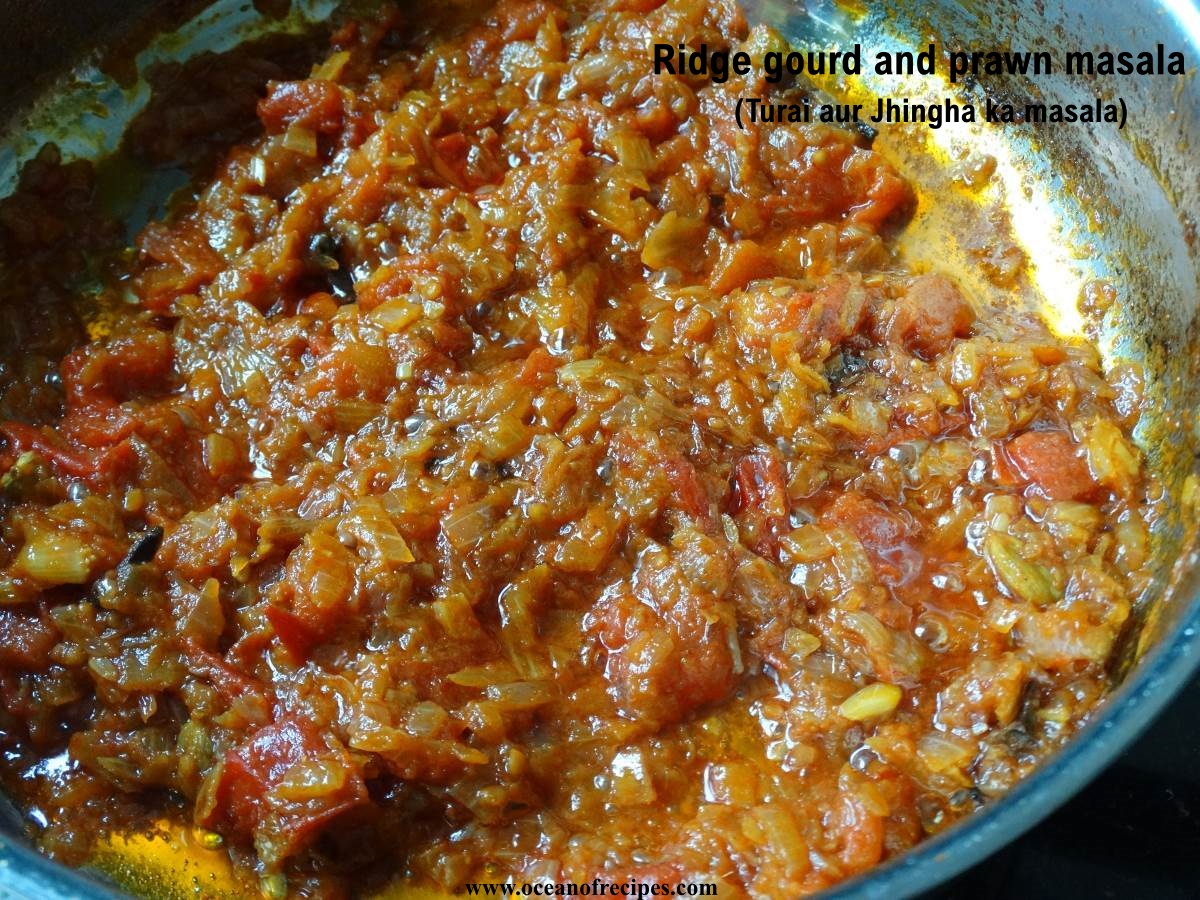
  • Add tomatoes.
  • Now add turmeric powder and chilli powder.
  • Mix well and saute for about 5 mins on medium to low flame with the lid closed. A few tablespoons of water can be added to avoid burning. Keep stirring occasionally to prevent it from sticking to the bottom of the pan.
  • Add 1/2 cup of water and cook for about 10 mins on a medium flame with the lid closed until all the water has been absorbed.
  • We have a basic onion and tomato curry base when the oil starts to separate.
  • Add ridge gourd and 1/2 cup of water.
  • Cook for about 20 mins on a medium flame with the lid closed until the ridge gourd is cooked well and becomes soft.
  • The ridge gourd curry is ready when the oil starts to separate.
  • Add prawns.
  • Add salt. Mix well and cook for 5 mins on medium heat or high heat.
  • Mix and simmer for about 10 to 12 mins with the lid closed until you get the consistency you desire.
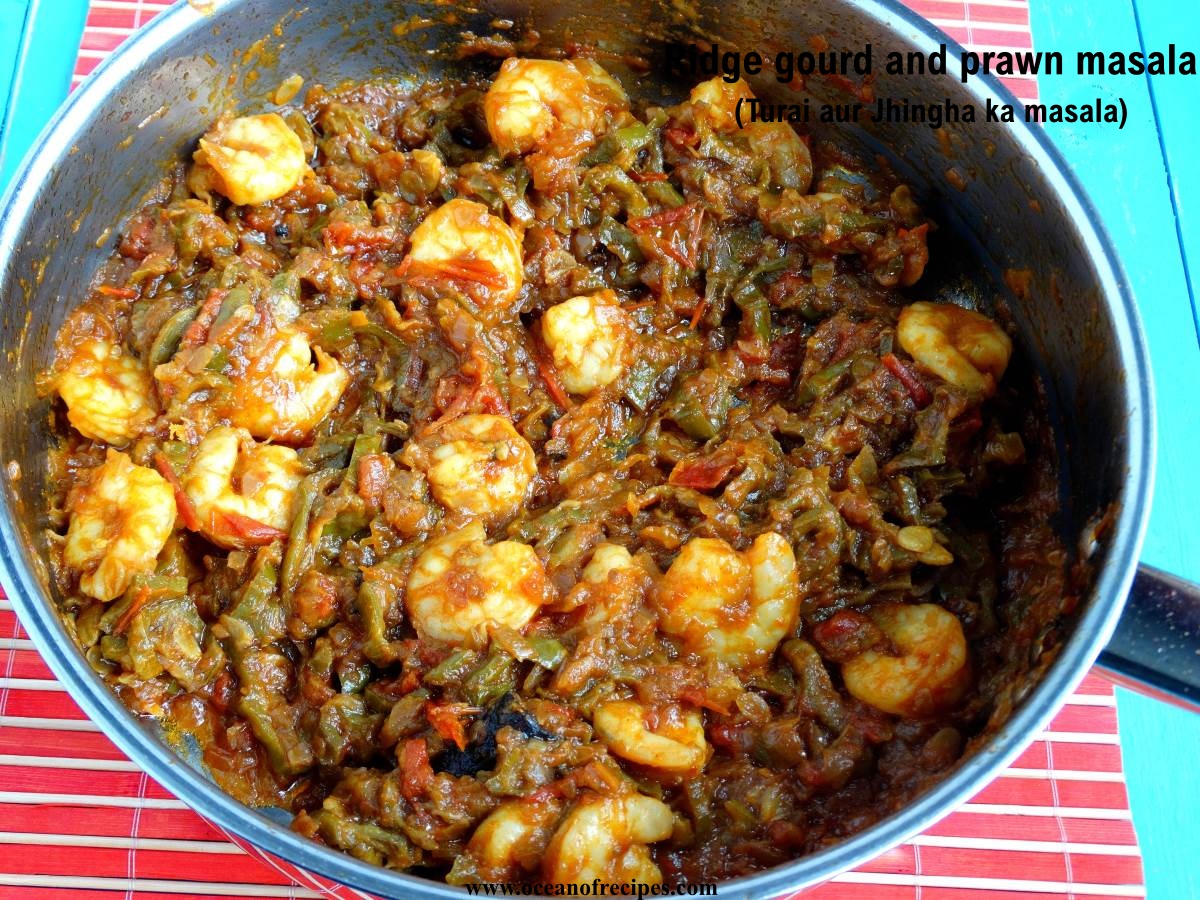
  • Oil starts to separate from the ridge gourd and prawns masala. Switch off.
  • Serve it with chapathi, roti, naan or plain rice. I specially like it with dal/rasam and plain rice. Here, I have served this with lemon rice.

Notes

  • In this recipe, you can add sliced onions instead of chopped onions.
  • If you are using a pressure cooker, first saute the onions with the whole spices, then add all the other ingredients at the same time and cook for 3 whistles on a medium flame. Open the lid after all the pressure is released. Simmer until you get the consistency you like and the oil starts to separate. It will be quick and easy.
  • Adding coriander powder and garam masala will give out a different taste.
  • If the curry becomes very dry while cooking, add water as required and cook.
  • I do not add water sometimes when ridge gourd is added to the onion mixture since when cooking on low flame with lid closed ridge gourd leaves water and shrinks. Stir in between. But to make it quick, I add water and cook on a high flame until it is cooked.
  • If you want the curry to be semi-dry, roast (bhuna style – saute or fry) for a while on medium low flame.

Ridge gourd and prawn masala (Turai aur Jhingha Masala)

Ridge gourd and prawn masala is a very popular dish in Andhra, known as Beerakaya Royyala masala in Telugu and Turai aur Jhinga ka masala in our home. Ridge gourd combined with prawns makes this dish very delicious and appetising. When Turai is cooked, it gives out a sweet flavour and taste. It also reduces a lot in quantity as Turai is made of lot of water. Buy Ridge gourd which are young and not the aged or ripened ones as it will be fibrous and not very good for consumption. You can refer to my ridge gourd and prawn curry which has very similar ingredients but the way of cooking is a bit different. If you are cooking in a vessel, use a good utensil as you will be stirring (bhuna/saute/fry) a lot to give a delicious taste to the Ridge gourd and prawn masala.
Prep Time15 mins
Cook Time1 hr
Total Time1 hr 15 mins
Cuisine: Andhra Pradesh
Servings: 3

Ingredients

  • 200 gms Raw prawns medium sized, peeled
  • 500 gms Turai sliced
  • 6 tbsp Oil
  • 250 gms Onion chopped
  • 250 gms Tomatoes chopped
  • 3 tsp Chilli powder
  • 1/4 tsp Turmeric powder
  • 1 tbsp Ginger and garlic paste
  • Salt – as per taste
  • 250 ml Water
  • 3 tbsp Coriander leaves

Whole spices

  • 6 Cloves
  • 5 Green cardamom
  • 1 Cinnamon stick 3 inch piece

Instructions

  • Wash the ridge gourd and slightly peel the skin at the ridges as shown.
  • Cut into thin slices and keep aside.
  • Add oil in a cooking vessel and when hot add the whole spices. Stir for about 10 seconds.
  • Add onions and cook for about 8 to 10 mins until soft, transparent and light golden in colour.
  • Add ginger and garlic paste. Saute for about 2 mins.
  • Add tomatoes.
  • Now add turmeric powder and chilli powder.
  • Mix well and saute for about 5 mins on medium to low flame with the lid closed. A few tablespoons of water can be added to avoid burning. Keep stirring occasionally to prevent it from sticking to the bottom of the pan.
  • Add 1/2 cup of water and cook for about 10 mins on a medium flame with the lid closed until all the water has been absorbed.
  • We have a basic onion and tomato curry base when the oil starts to separate.
  • Add ridge gourd and 1/2 cup of water.
  • Cook for about 20 mins on a medium flame with the lid closed until the ridge gourd is cooked well and becomes soft.
  • The ridge gourd curry is ready when the oil starts to separate.
  • Add prawns.
  • Add salt. Mix well and cook for 5 mins on medium heat or high heat.
  • Mix and simmer for about 10 to 12 mins with the lid closed until you get the consistency you desire.
  • Oil starts to separate from the ridge gourd and prawns masala. Switch off.
  • Serve it with chapathi, roti, naan or plain rice. I specially like it with dal/rasam and plain rice. Here, I have served this with lemon rice.

Notes

  • In this recipe, you can add sliced onions instead of chopped onions.
  • If you are using a pressure cooker, first saute the onions with the whole spices, then add all the other ingredients at the same time and cook for 3 whistles on a medium flame. Open the lid after all the pressure is released. Simmer until you get the consistency you like and the oil starts to separate. It will be quick and easy.
  • Adding coriander powder and garam masala will give out a different taste.
    If the curry becomes very dry while cooking, add water as required and cook.
  • I do not add water sometimes when ridge gourd is added to the onion mixture since when cooking on low flame with lid closed ridge gourd leaves water and shrinks. Stir in between. But to make it quick, I add water and cook on a high flame until it is cooked.
  • If you want the curry to be semi-dry, roast (bhuna style – saute or fry) for a while on medium low flame.

Mango milkshake

Mango milkshake is one of my favourite drinks during summers and the most popular in Mango season. I always prepare my mango milkshake with fresh ripe mangoes either Alphonso or Banganapalle. If they are not available, just use any good, ripe and sweet mangoes. Avoid the fibrous mangoes. Mango milkshake is very easy to prepare – simply blend the mango, milk and ice cream.

Preparation time: 15 mins

Cooking time: 20 mins

Cuisine: India

Serves: 2 to 3

Ingredients

  • Ripe mango – 1 (big size) or 400 gms
  • Milk – 1 cup
  • Vanilla ice cream – 2 scoops
  • Sugar – 1 tbsp
  • For garnishing

  • Mango puree – 2 tbsp (optional)
  • Mango pieces – 2 tbsp

Method

  • I have used one Banganapalle mango. Instead you can use two Alphonso mangoes as well.
  • Peel the mango, chop and keep aside in a bowl. Reserve a few pieces for garnishing later.
  • Put the remaining mango pieces in a mixer or blender.
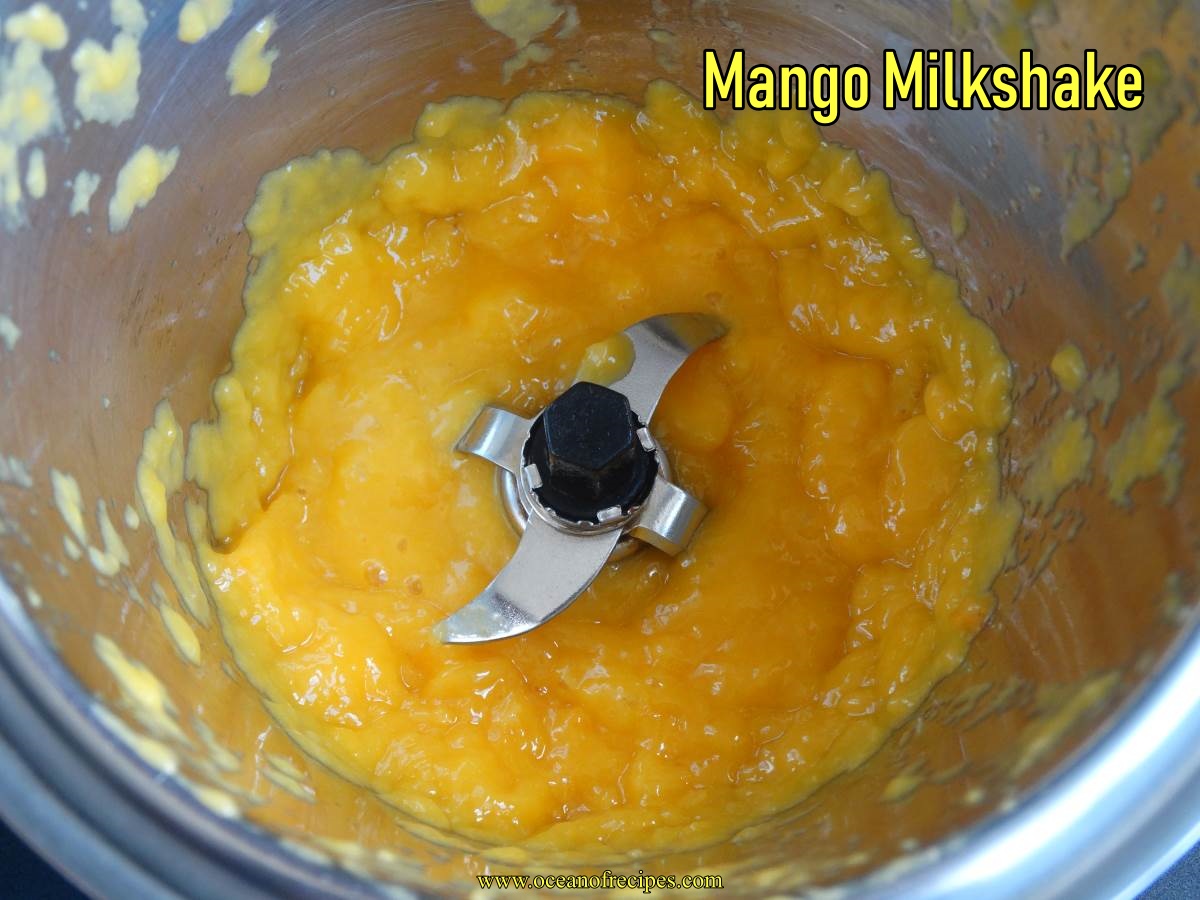
  • Blend until it is a smooth puree.
  • Take a couple of tablespoons of mango puree in a separate bowl for garnishing later. If the puree is thick add a little milk and bring it to a pouring consistency. The mango puree has to be dark, so do not add too much milk.
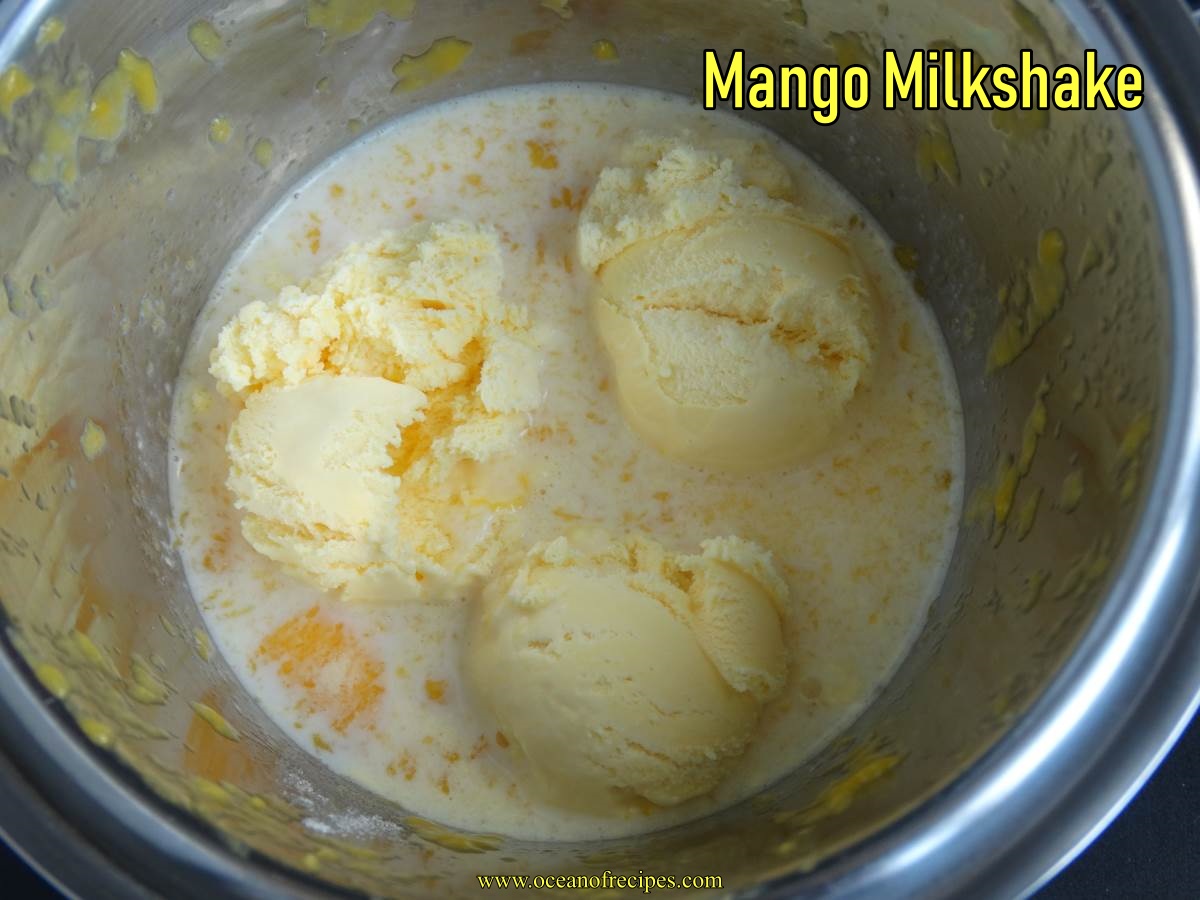
  • Add milk, vanilla ice cream and sugar as per taste to the blender and blend to a smooth thick milkshake.
  • Pour the thick mango milkshake into serving glasses leaving some space for the garnishing.
  • Drizzle 1 tbsp of mango puree in each glass and place a few mango pieces on top of the mango puree as the garnish.
  • Serve the Mango Falooda immediately with a spoon and a straw to enjoy.

Notes

  • The mango I used were very ripe and sweet. So, I required only one. You can add more than one mango depending on the taste of the mango.
  • You can use mango ice cream instead of vanilla ice cream.
  • You can garnish the mango milkshake with sliced almonds, pista and cashew as per your choice.
  • You can add one scoop of vanilla ice cream in each glass on top of the milkshake. Then place few mango pieces or drizzle mango puree on top of the ice cream.

Mango milkshake

Mango milkshake is one of my favourite drinks during summers and the most popular in Mango season. I always prepare my mango milkshake with fresh ripe mangoes either Alphonso or Banganapalle. If they are not available, just use any good, ripe and sweet mangoes. Avoid the fibrous mangoes. Mango milkshake is very easy to prepare - simply blend the mango, milk and ice cream.
Prep Time15 mins
Cook Time20 mins
Total Time35 mins
Cuisine: Indian
Keyword: mango milkshake
Servings: 3

Ingredients

  • 1 Ripe mango (big)
  • 1 cup Milk
  • 2 scoops Vanilla ice cream
  • 1 tbsp Sugar

For garnishing

  • 2 tbsp Mango puree (optional)
  • 2 tbsp Mango pieces

Instructions

  • I have used one Banganapalle mango. Instead you can use two Alphonso mangoes as well.
  • Peel the mango, chop and keep aside in a bowl. Reserve a few pieces for garnishing later.
  • Put the remaining mango pieces in a mixer or blender.
  • Blend until it is a smooth puree.
  • Take a couple of tablespoons of mango puree in a separate bowl for garnishing later. If the puree is thick add a little milk and bring it to a pouring consistency. The mango puree has to be dark, so do not add too much milk.
  • Add milk, vanilla ice cream and sugar as per taste to the blender and blend to a smooth thick milkshake.
  • Pour the thick mango milkshake into serving glasses leaving some space for the garnishing.
  • Drizzle 1 tbsp of mango puree in each glass and place a few mango pieces on top of the mango puree as the garnish.
  • Serve the Mango Falooda immediately with a spoon and a straw to enjoy.

Notes

  • The mango I used were very ripe and sweet. So, I required only one. You can add more than one mango depending on the taste of the mango.
  • You can use mango ice cream instead of vanilla ice cream.
  • You can garnish the mango milkshake with sliced almonds, pista and cashew as per your choice.
  • You can add one scoop of vanilla ice cream in each glass on top of the milkshake. Then place few mango pieces or drizzle mango puree on top of the ice cream.

Mango falooda

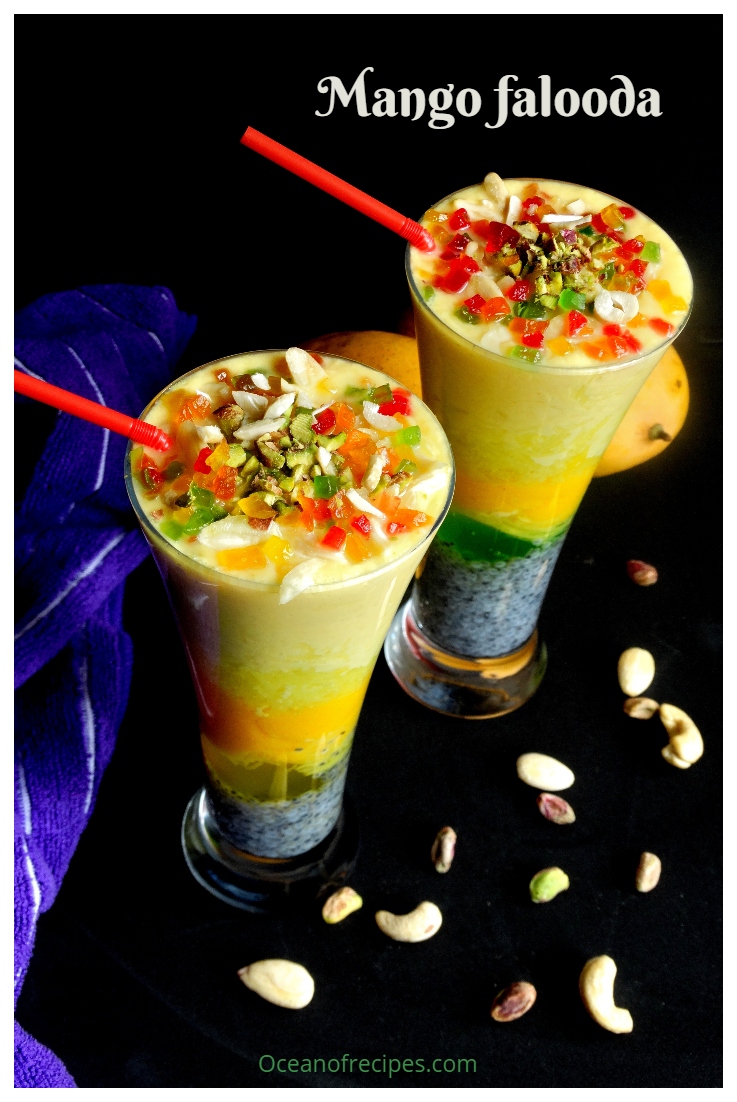
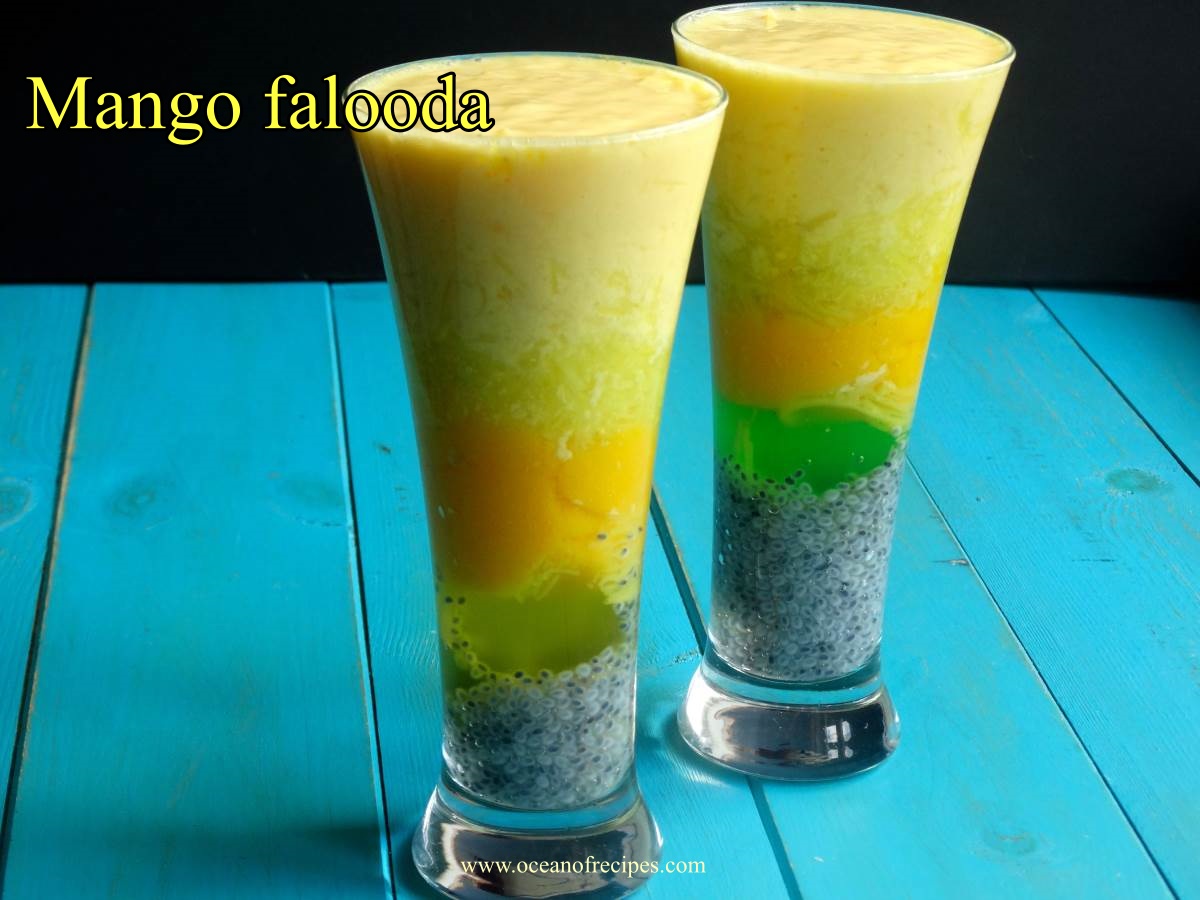
Mango falooda is a great dessert for hot summers to quench thirst. It is cold, icy and filling as well. It is a summer treat for mango lovers in mango season. Falooda is a very popular Indian dessert/cold beverage with a variety of toppings/layers, ice cream or kulfi. Traditionally, falooda is served in layers with a combination of basil seeds, jellies, fresh fruits, colourful vermicelli, rabri (reduced milk), rose coloured and flavoured milk, ice cream or kulfi along with cashews, almonds and pistachios for garnishing. Traditional falooda is easily available in restaurants but mango falooda will be available only during the mango season and also not easily available in every restaurant. But the mango falooda can be made easily at home with a few ingredients which are easily available in Indian stores.

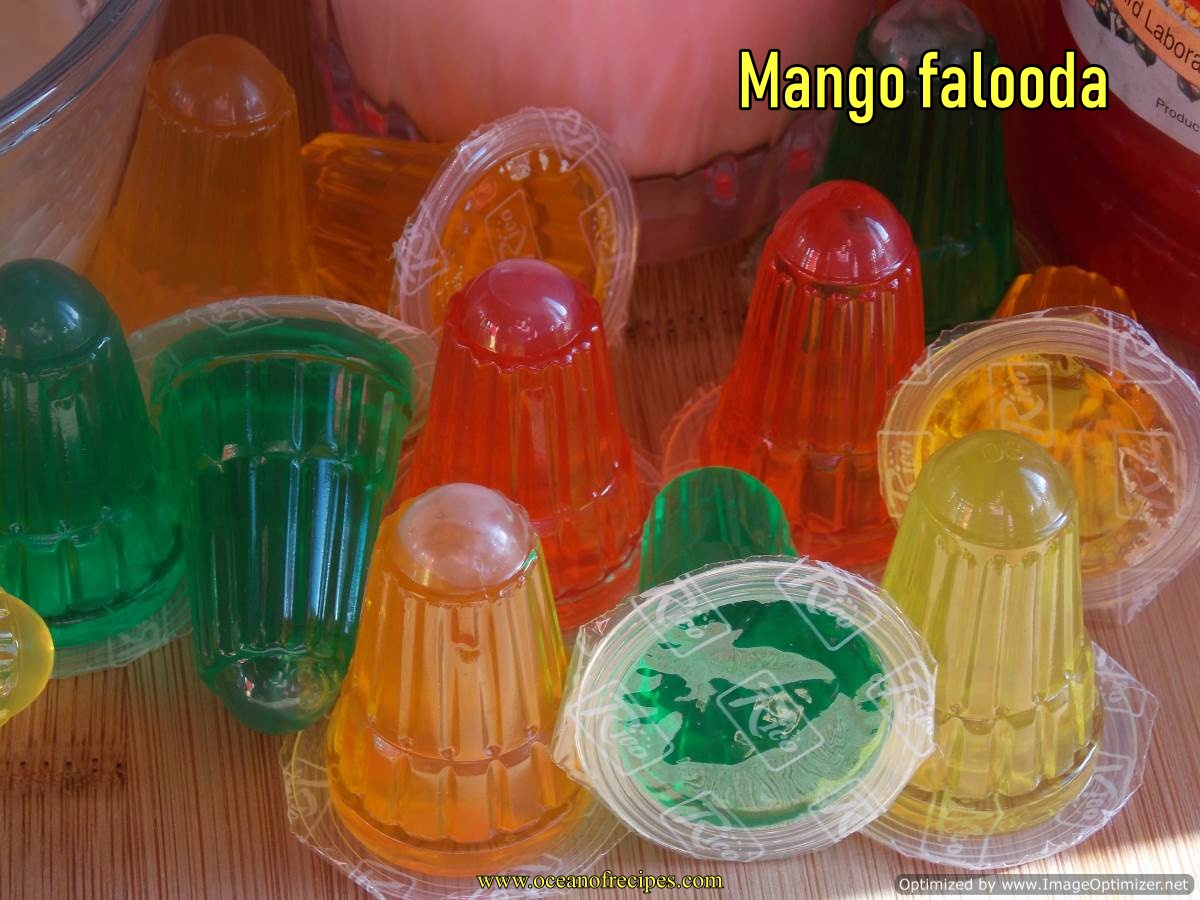
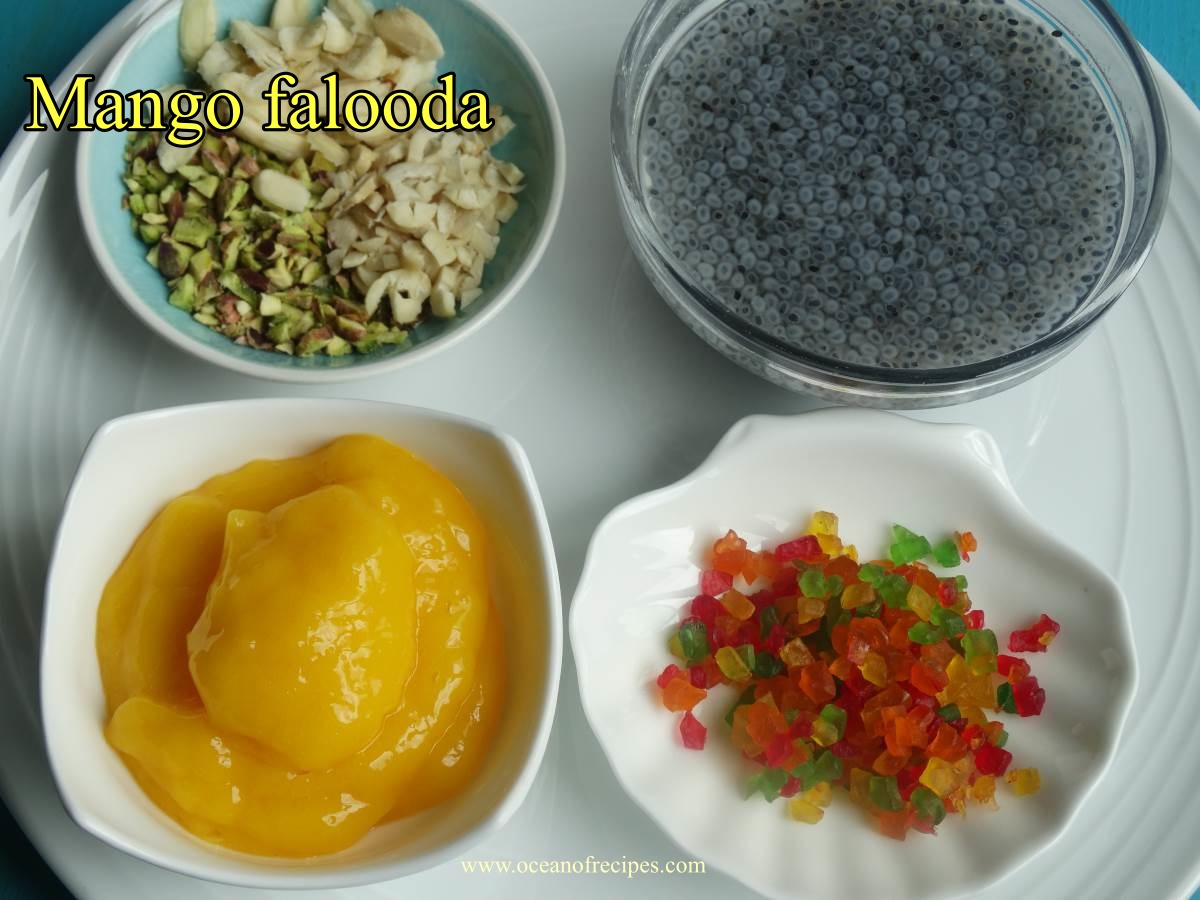
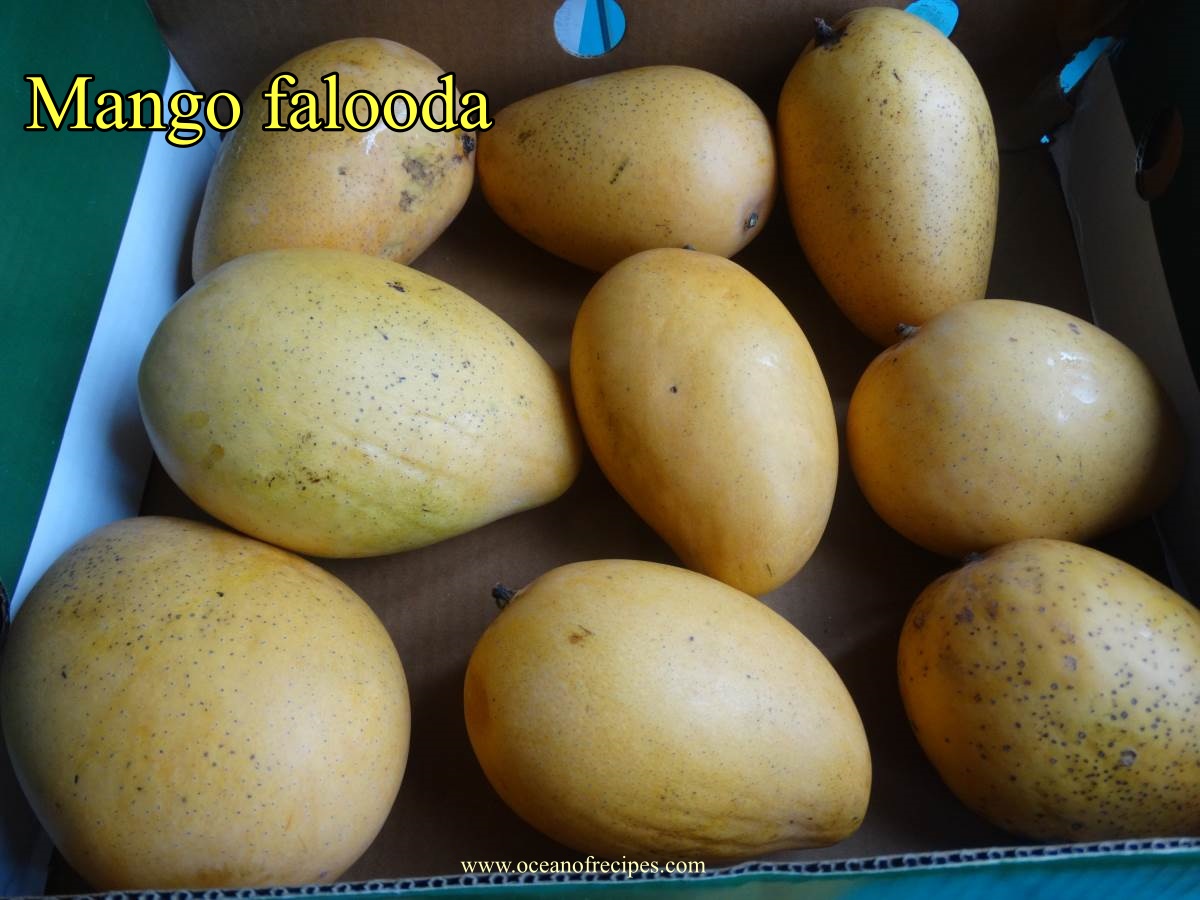
I have prepared my mango falooda as per my taste and availability of ingredients like falooda noodles, basil seeds, colourful jellies, tutti frutti , nuts and of course ripe mango. Falooda sev (noodles) is easily available in shops with different colours (I have used yellow as it is mango falooda). Basil seeds are also known as sabja, sweet basil seeds, chia or tukmaria seeds. Basil seeds are healthy and can act as a coolant for your body in summer. If you want to make it more exotic, then fresh fruits like mango, apple, kiwi, peach, strawberries or any fruit you like can be used. The only thing you need is to buy all these ingredients in advance. So, make this luscious mango falooda during summers and in mango season to impress your friends and family. Mango falooda is a great addition for parties and get togethers.

Preparation time: 15 mins

Cooking time: 20 mins

Cuisine: India

Serves: 2 to 3

Ingredients

  • Falooda sev – 1 cup or 25 gms
  • Sabja seeds – 1 tbsp
  • Jelly (any colour) – 10
  • Ripe mangoes – 1 (big size) or 400 gms
  • Milk – 1 cup
  • Vanilla ice cream – 2 scoops
  • Sugar – 1 tbsp
  • Garnishing

  • Pistachios – 10
  • Cashew nuts – 10
  • Almonds (blanched) – 10
  • Tutti frutti – 2 tbsp

Method

  • Soak almonds in hot water for a few minutes. Peel the skin and then chop or slice them. Keep ready.
  • Chop the pistachios and cashews, keep aside.
  • Soak sabja seeds in water for 1 hour or until they swell. Drain the water and keep aside. Sometimes I soak sabja seeds in Rooh Afza or rose syrup to get that dark pink colour.
  • Boil falooda sev according to package instructions. When it is cooked, immediately rinse in cold water and keep it in the cold water for a few minutes to retain its colour. Drain the water and keep aside. Allow it to cool completely.
  • Making milk shake

  • I have used one Banganapalle mango. Instead you can use two Alphonso mangoes as well.
  • Peel the mango, chop and keep aside in a bowl. Reserve some mango pieces for falooda.
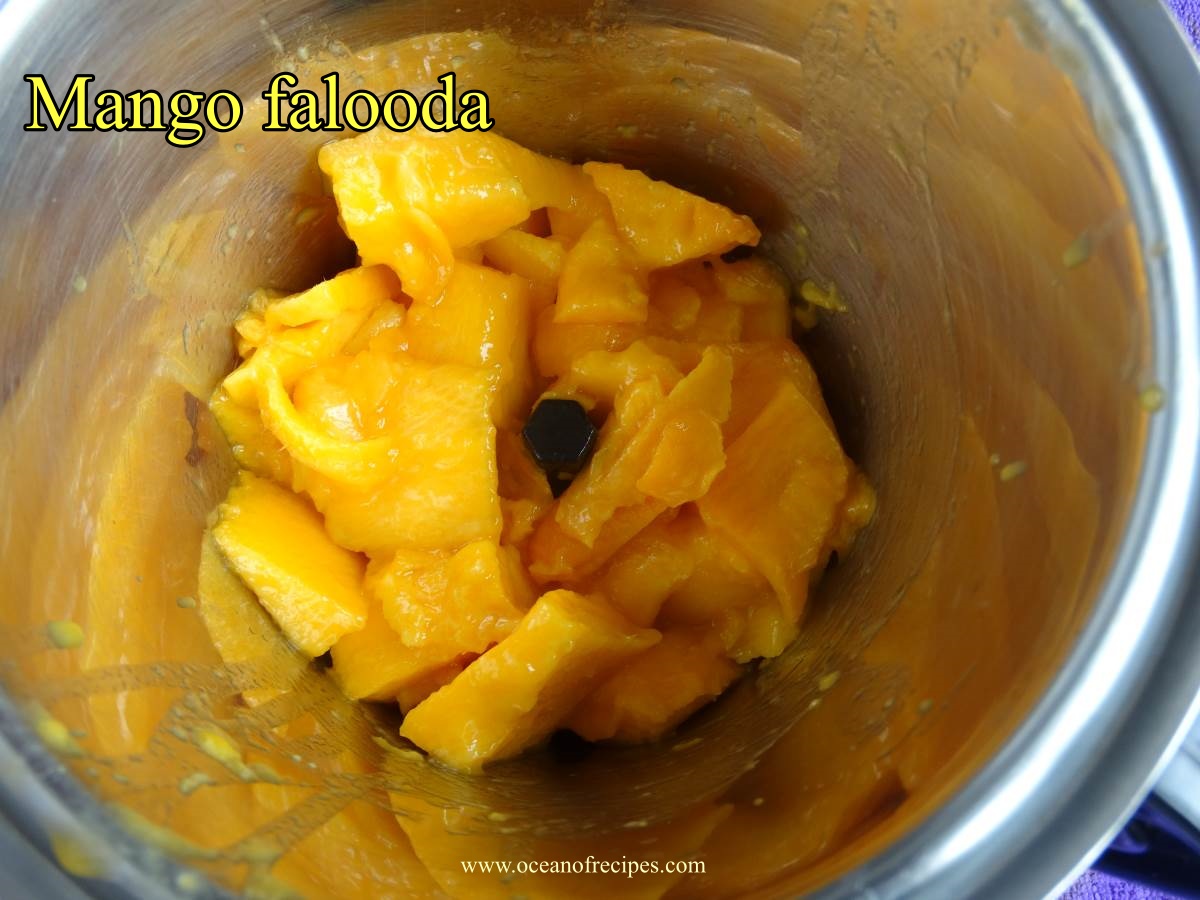
  • Put the remaining mango pieces in a mixer or blender.
  • Blend until it is a smooth puree. Reserve a few tablespoon of the mango puree (optional) in a small bowl and keep it aside.
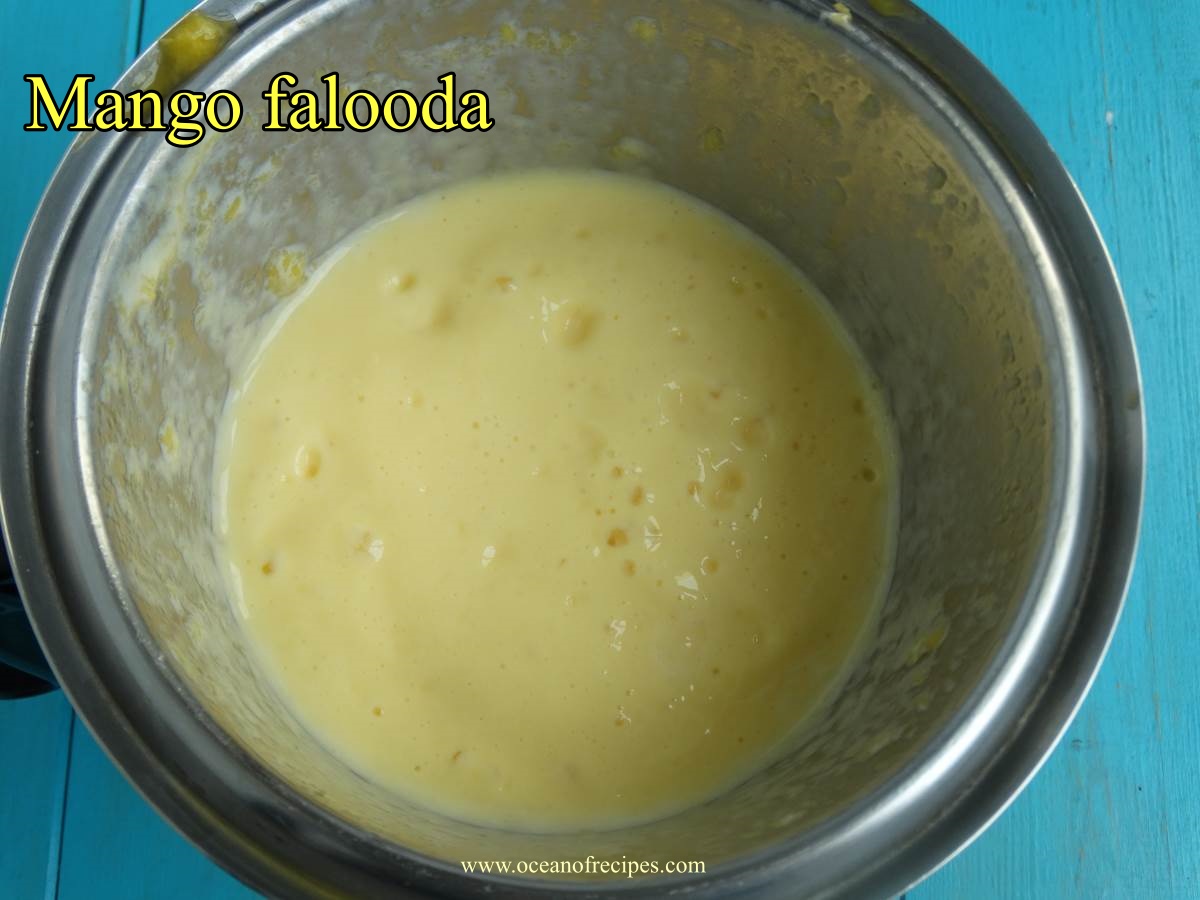
  • Add milk, vanilla ice cream and sugar as per taste to the blender and blend to a smooth thick milkshake.
  • Preparing mango falooda

  • Take 2 glasses, add 1 tbsp of sabja seeds in each glass at the bottom as first layer. Then add 2 tbsp of mango jelly (or any colour/flavour) as the second layer.
  • Add 1 to 2 tbsp of chopped mango pieces as the third layer followed by an optional 1 tbsp of mango puree.
  • Add falooda sev for the next layer and then fill with mango milkshake leaving enough space for garnishing.
  • You can top it with your favourite ice cream and then garnish with chopped pistachios, cashews, almonds and tutti frutti.
  • Serve the Mango Falooda immediately with a spoon and a straw to enjoy.

Notes

  • You can also use mango ice cream instead of vanilla ice cream.
  • Sometimes, I crush or grind the pistachios and cashews into a coarse powder and then use it for garnishing the falooda.
  • You can layer the falooda in any order as per your taste and choice.
  • You can add rabri or condensed milk for the mango falooda and it gives different taste.
  • Add sugar to the milkshake as per the sweetness of the mango.

Mango mastani

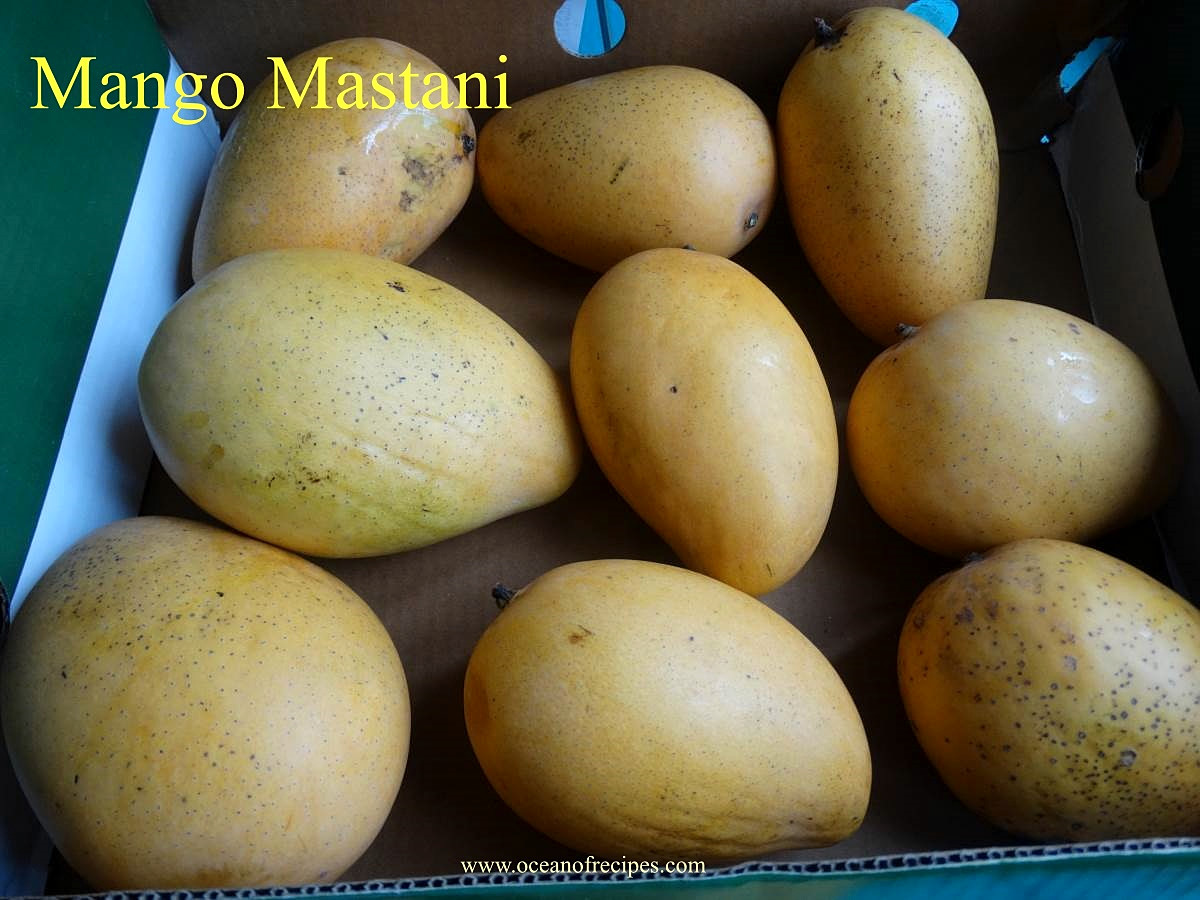
Mango mastani is a popular and refreshing drink for hot summers that originated in Pune. Mastani is a dessert drink made with thick milkshake and ice cream, available in a variety of flavours like vanilla, sitaphal (sugar-apple), chocolate, dry fruits, kesar (saffron), etc. Although mango mastani is available anywhere in Pune, to taste different varieties of mastani, one can visit Sujata mastani in Pune. When you order any mastani drink, it will come topped with ice cream and nuts.

This drink is named after the queen Mastani who was the beautiful lover and second wife of Peshwa Bajirao, a legendary Peshwa ruler. There is also a Bollywood movie named Bajirao mastani based on their love story.

Mango mastani is very easy to prepare at home either with vanilla ice cream or mango ice cream, once you have all the ingredients handy.

Preparation time: 15 mins (excludes time for soaking almonds)

Cooking time: 20 mins

Cuisine: Maharashtra

Serves: 2 to 3

Ingredients

  • Ripe mangoes – 1 (big size) or 400 gms
  • Milk – 2 cups
  • Vanilla ice cream – 2 scoops
  • Chopped ripe mango – 4 tbsp
  • Sugar – 2 tbsp
  • For garnishing

  • Mango puree – 2 tbsp (optional)
  • Chopped almonds (badam) – 2 tbsp
  • Chopped pistachios (pista) – 2 tbsp
  • Chopped cashews (kaju) – 2 tbsp
  • Tutti frutti – 2 tbsp
  • Mango pieces – 2 tbsp

Method

  • I have used one Banganapalle mango. Instead you can use two Alphonso mangoes as well.
  • Soak 5 to 8 almonds in hot water for about 30 mins to make the peeling of skin easier. Peel the skin of the almonds and keep them aside.
  • Chop or slice the almonds, pista and cashews for garnishing. Keep them aside.
  • Peel the mango, chop and keep aside in a bowl. Reserve a few for putting inside the glass and few for garnishing the mastani later.
  • Put the remaining mango pieces in a mixer or blender.
  • Blend until it is a smooth puree.
  • Save a couple of tablespoons of the mango puree in a separate bowl for decorating inside the glass later on. If the puree is thick, add a little milk and bring it to a pouring consistency. The puree has to be dark.
  • Add milk and sugar as per taste to the blender and blend to a smooth thick milkshake.
  • Tilt the serving glass at 45 degrees angle and start pouring the saved mango puree inside the glass.
  • Optionally, turn the glass as you pour the puree to swirl all around the glass. It is just for decorating the glass or for a design inside the glass.
  • Add a couple of tablespoons of mango pieces in each glass.
  • Pour the thick mango milkshake into the glasses, leaving enough space for topping with ice cream and garnishing.
  • Place one scoop of vanilla ice cream in each glass on top of the milkshake.
  • Place a few mango pieces on top of the ice cream.
  • Sprinkle or garnish with tutti frutti, almonds, cashews and pista.
  • Serve the Mango Mastani immediately with a spoon and a straw to enjoy.

Notes

  • The mango I used were very ripe and sweet. So, I required only one. You can add more than one mango depending on the taste of the mango.
  • You can also use mango ice cream instead of vanilla ice cream.
  • I forgot to garnish with fresh cherry in picture, but you can garnish with a glazed cherry to complete the look, although entirely optional.
  • You can garnish with nuts, tutti frutti and mango pieces in any order as per your choice.

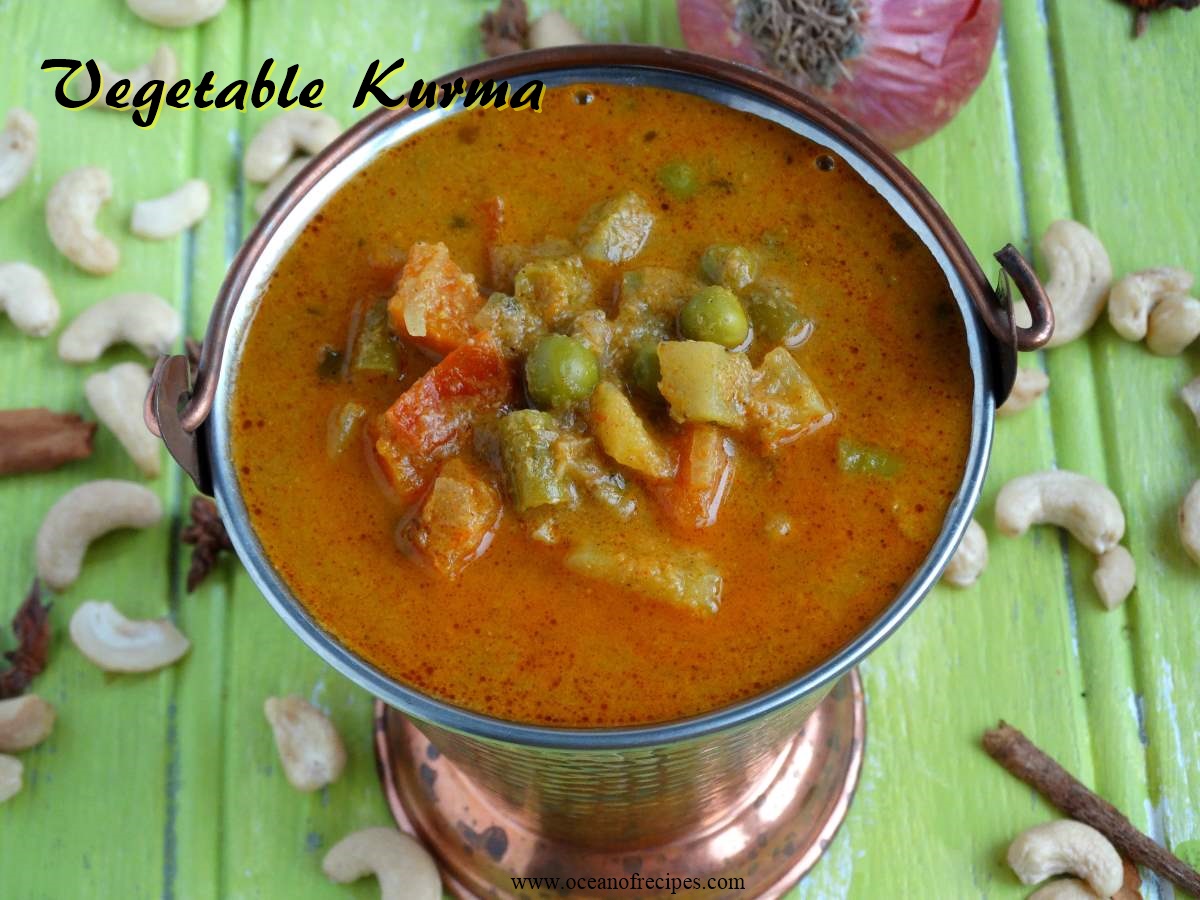
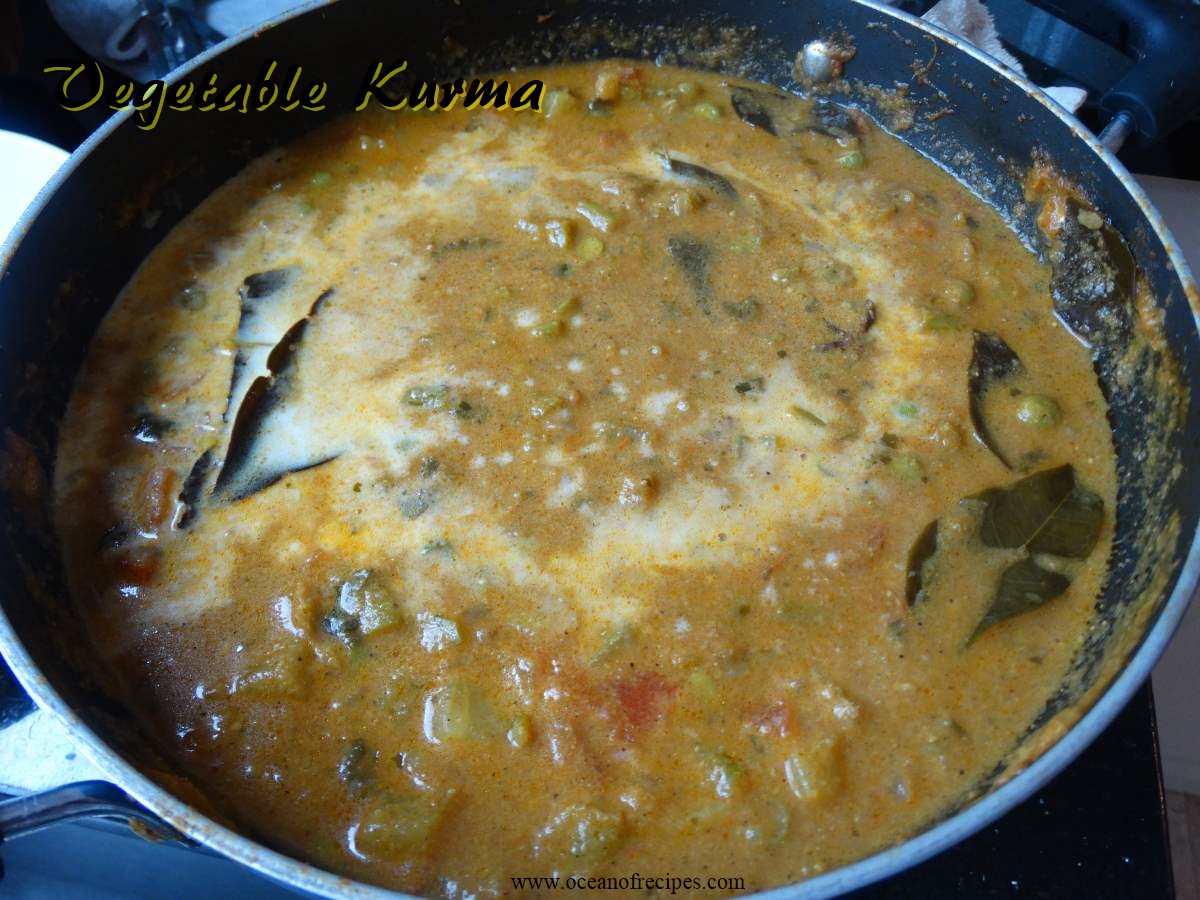
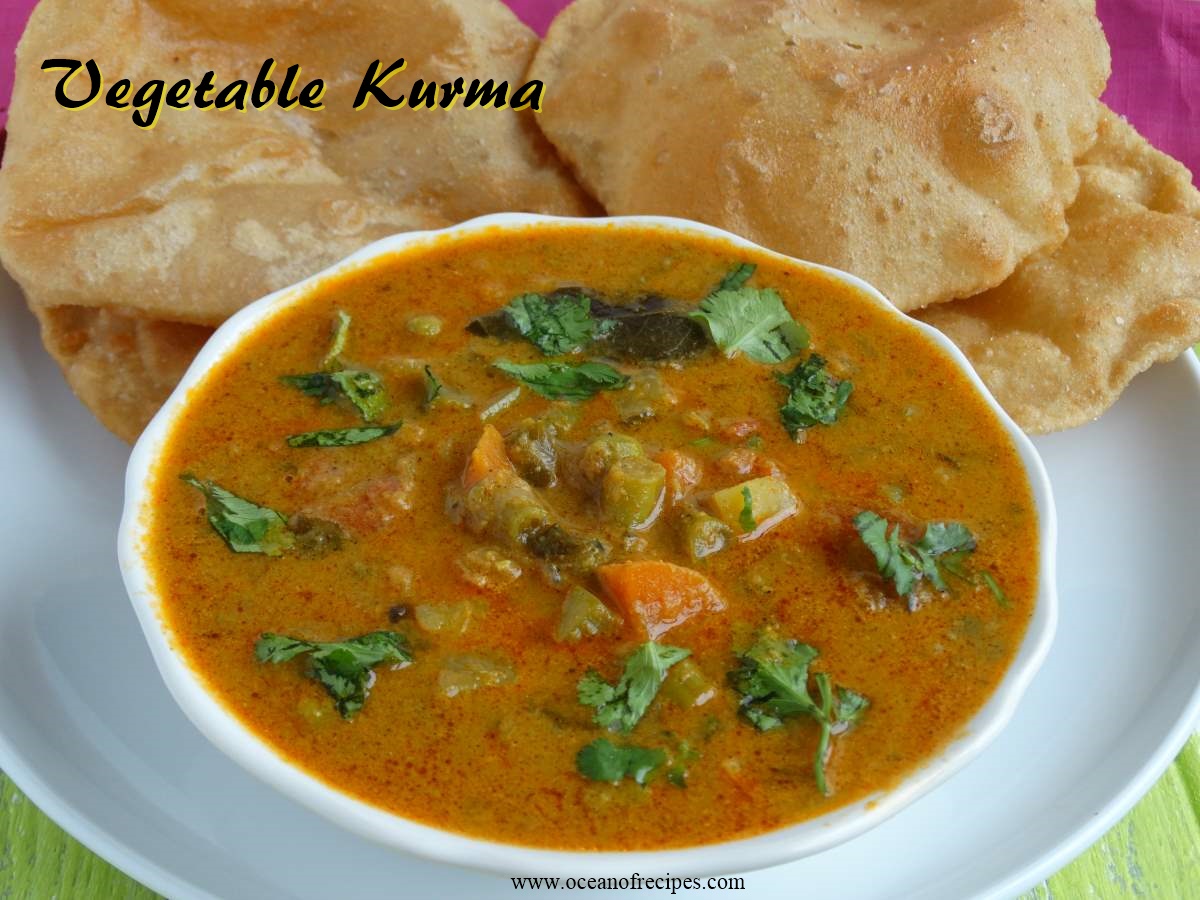
Vegetable Kuruma

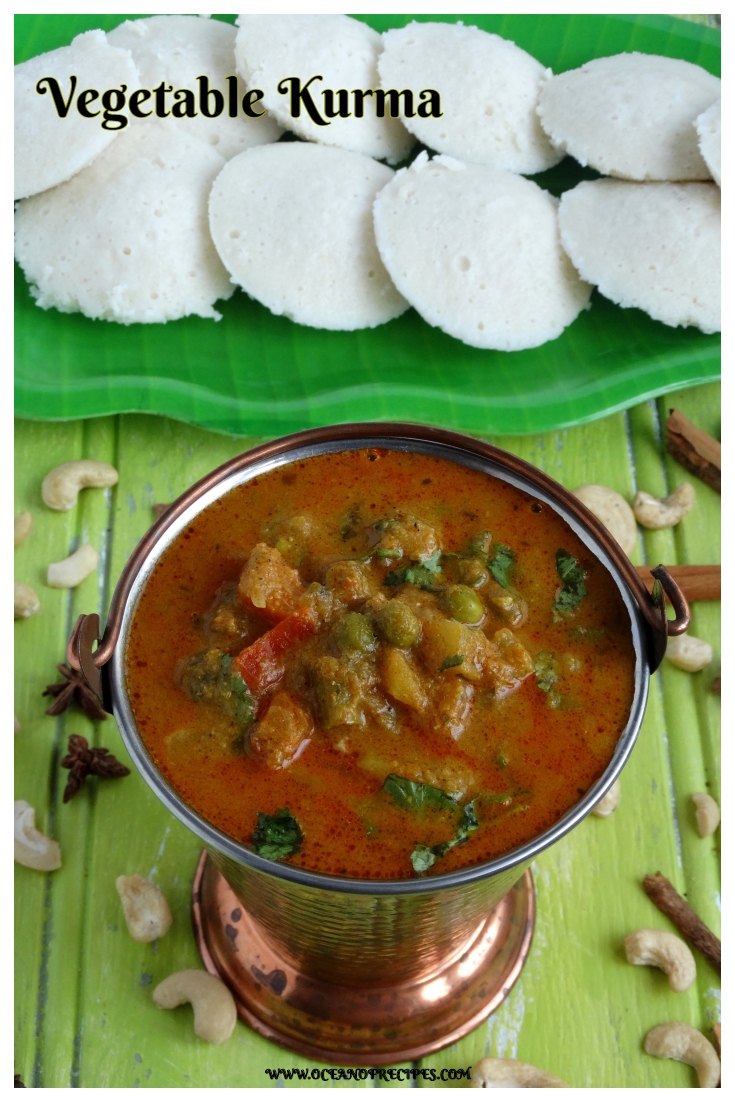
Vegetable kurma is a mixed vegetable curry very popular dish in south Indian restaurants and prepared in each house in households with their own variations and as per their taste. Though it has become so popular that everybody names Saravana style vegetable kurma although it is widely available in every South Indian restaurants. I have tasted different kinds of kurma from different South Indian restaurants I liked all. The combo for vegetable kurma is parotta, puri, chapathi, Idli, dosa, Idiappam and any pulao.

For a restaurant style vegetable kurma, you need to have kalpasi (in Tamil) which is mostly used in chettinand cuisine. Kalpasi known as dagad ka phool in Hindi, black stone flower in English. Apart from other ingredients, the main ingredient which makes this vegetable kurma different from other kurma is curd, milk and butter adding in the end. My favourite combo to go with vegetable kurma is idli and dosa.

Preparation time: 20 mins (excluding soaking time)

Cooking time: 50 mins

Cuisine: Tamil Nadu

Spiciness: Mild

Serves: 3 to 4

Ingredients

  • Oil – 4tbsp
  • Onion – 1(80gms)
  • Ginger and garlic paste – 1tbsp
  • Tomato – 1(150gms)
  • Curry leaves – 15
  • Chilli powder – 11/2tsp
  • Turmeric powder – 1/4tsp
  • Garam masala – 1tsp
  • Water – 21/2cups
  • Yoghurt – 1tbsp
  • Milk – 1/2cup
  • Butter – 1tbsp
  • Coriander leaves – 3tbsp
  • Whole spices

  • Bay leaf – 1(big)
  • Green cardamom – 4
  • Cloves – 5
  • Cinnamon stick – 1(3inch)
  • Fennel seeds – 1/2tsp
  • Star anise – 1
  • Paste

  • Star anise – 1
  • Fennel seeds – 1tsp
  • Green cardamom – 4
  • Star anise – 1
  • Black stone flower (kalpasi) – 1tsp
  • Fresh coconut – 4tbsp
  • Kush kush – 1tsp
  • Cashew nuts – 5
  • Onion – 1 small or 80gms
  • Tomato – 80gms
  • Vegetables

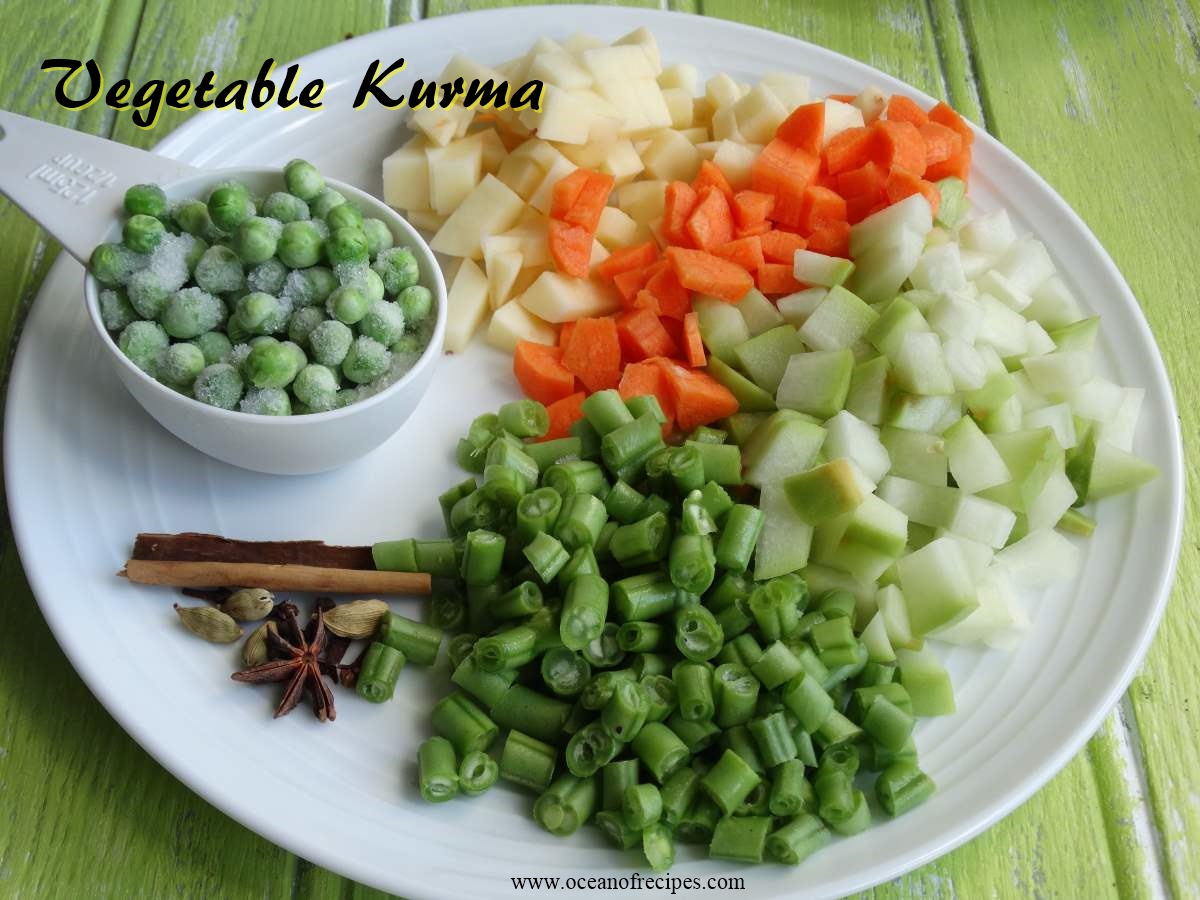
  • Chow chow – ½
  • Carrot – 1
  • Potato – 1(small)
  • Beans – 12
  • Peas – 1/4 cup

Method

  • Chop onion, tomatoes and coriander leaves finely. I have used frozen peas.
  • Precook the vegetables with turmeric 1/4tsp with adequate water11/2cup. The vegetable has to be firm when cooked or add the raw vegetables when the paste is added and cook along with it.
  • Soak cashew nuts and khus khus in hot water for 30minutes.
  • Add all the ingredients for the paste in a mixer, including cashew nuts and khus khus, grind to a fine paste. Add water if required.
  • Heat oil in a vessel; add all the whole spices, fry for 7 to 10 seconds.
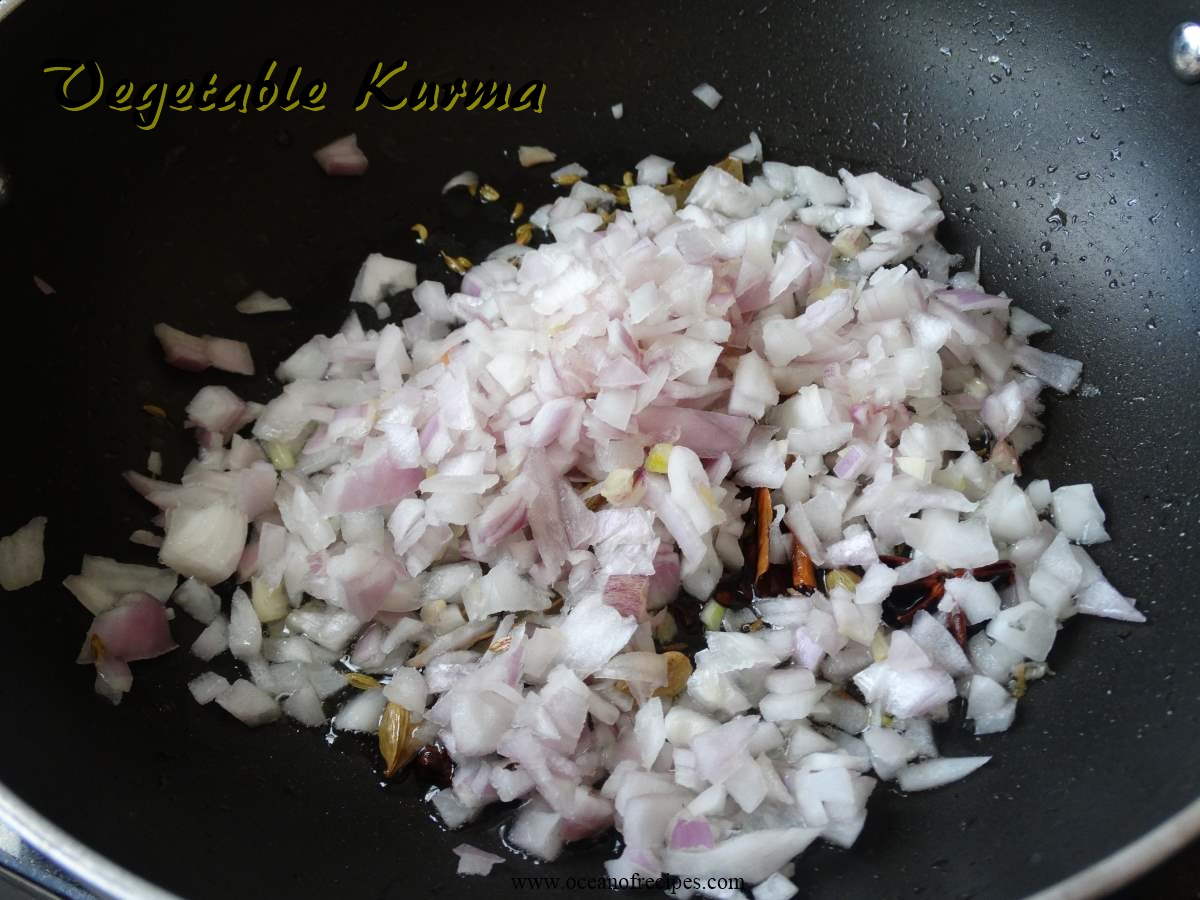
  • Add onion and curry leaves, suate until onion is soft and transparent.
  • Add ginger and garlic paste saute for few seconds.
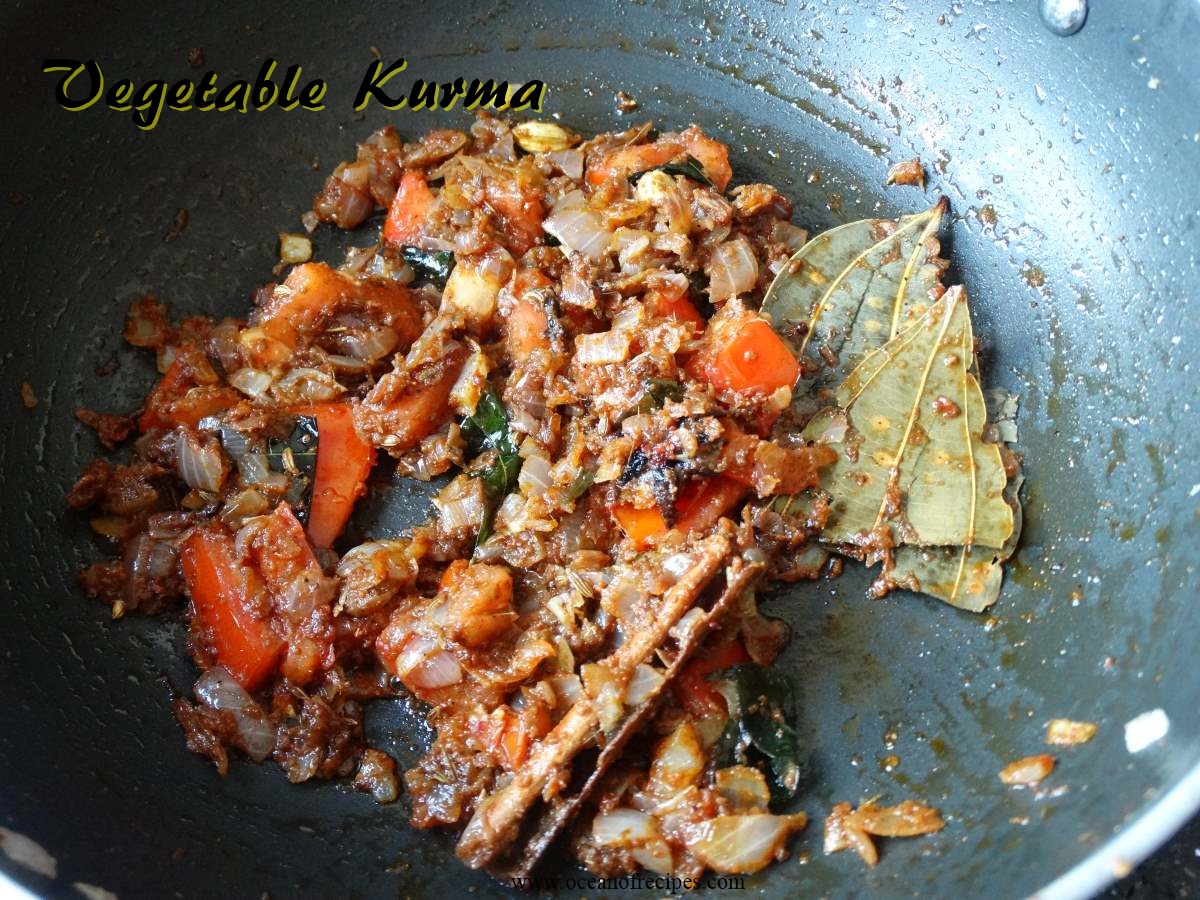
  • Add chopped tomatoes and add all the spices cook until tomatoes becomes soft (add little water to avoid spices to burn).
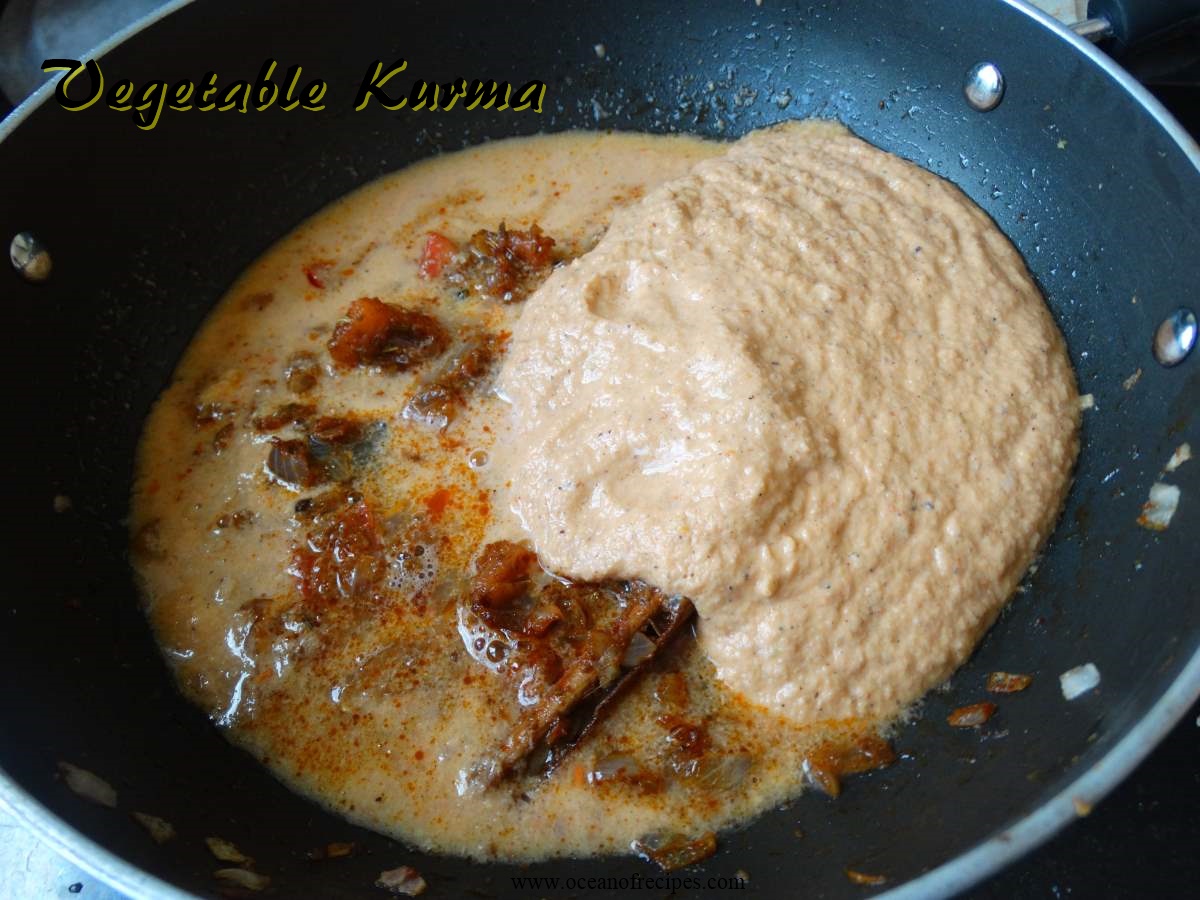
  • Add the paste and 11/2cups water (the water 1/3rd used to clear the left over paste attached inside the mixer) mix well.
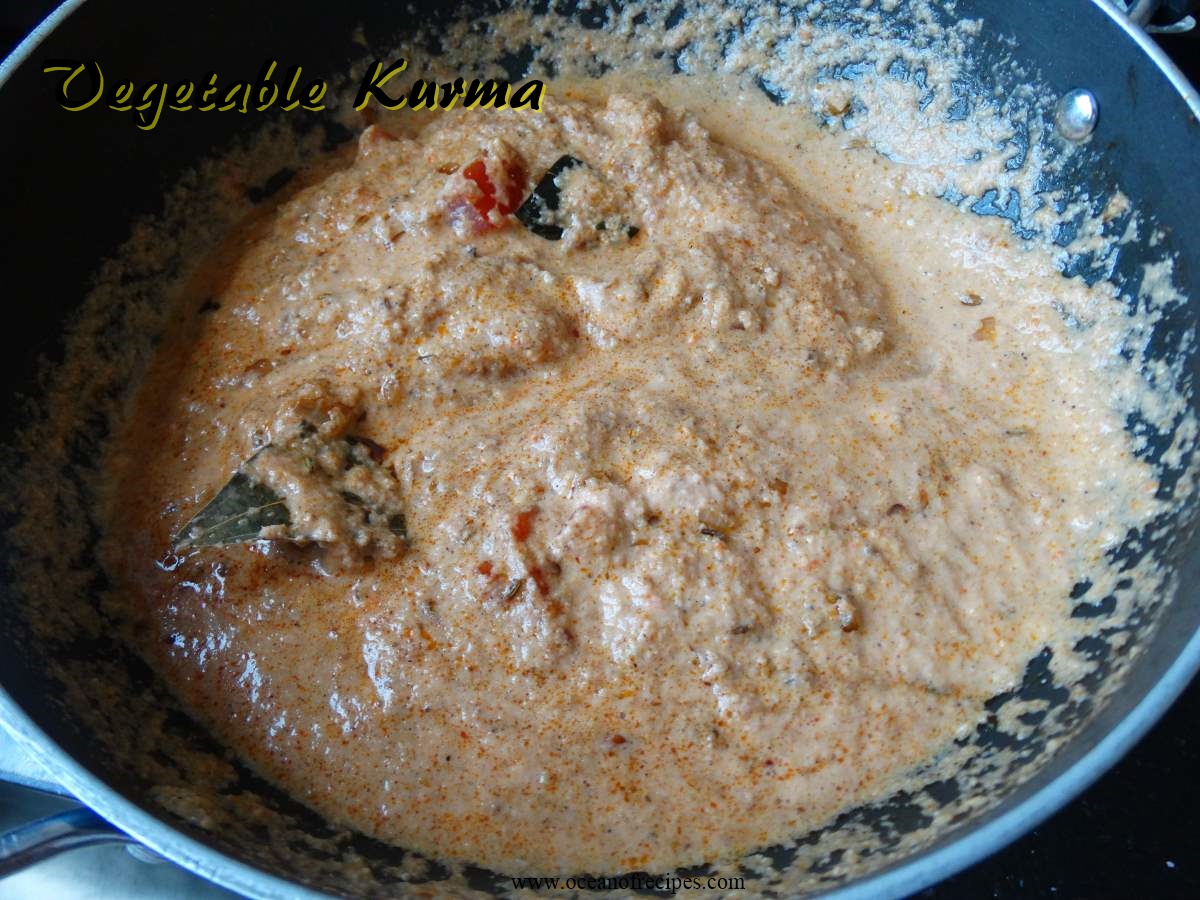
  • Cook for 15minutes on medium flame, until it starts leaving oil. stir in-between. In the paste there is raw onion, it has to be cooked well.
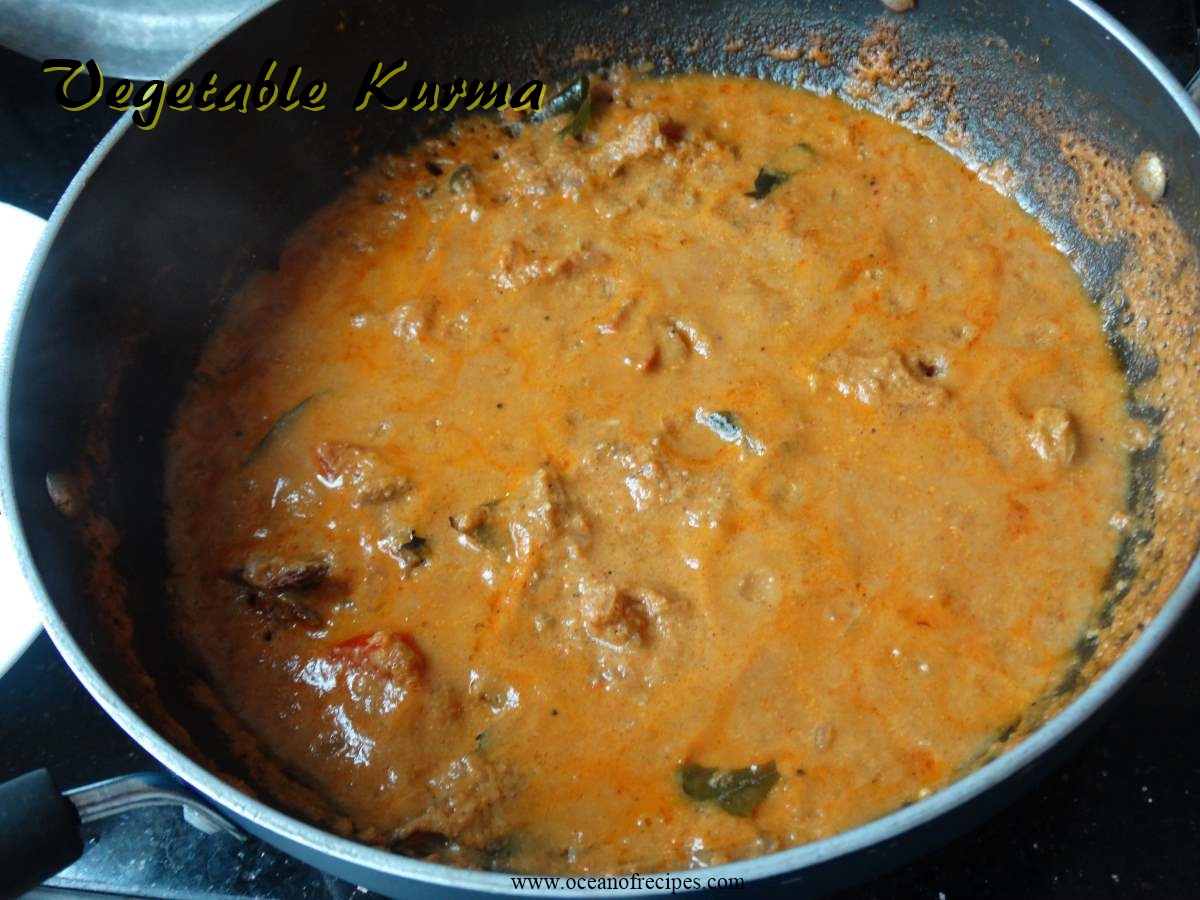
  • Add water 1/2cup or any left over water from the precooked vegetables, to loosen the curry.
  • Add yoghurt, mix quickly at low flame.
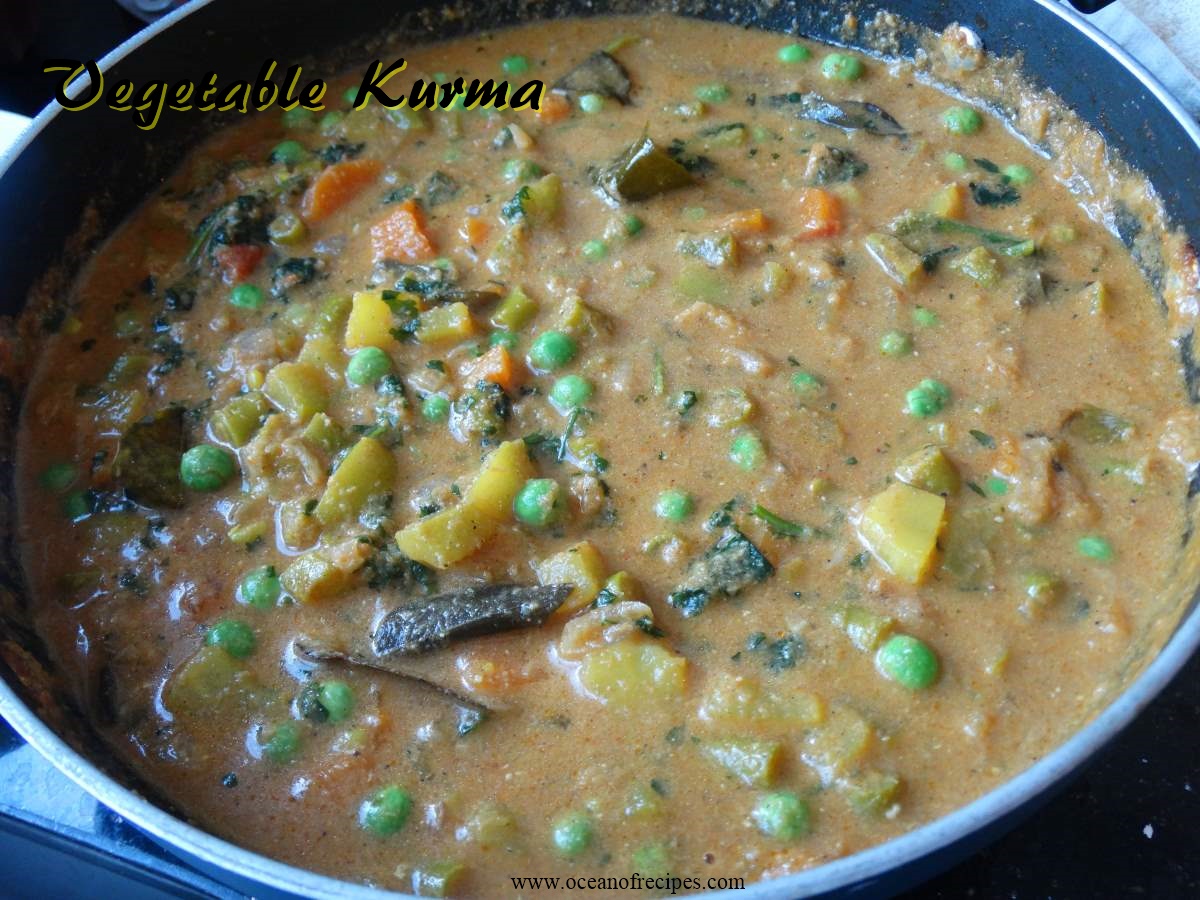
  • Add precooked vegetables, butter and milk mix well.
  • Cook for 15 minutes on low flame, until it has left oil on top of the curry. Switch off.
  • Garnish with coriander leaves.
  • I have served vegetable kurma with my favourite combo idli and puri.

Notes

  • Can add raw vegetables when the paste is added and cook until both are cooked well.
  • Add water as per the requirement and the consistency you required.
  • Can cook the tomatoes until soft and then add the spices and cook for few minutes.